

Why Governance Failures Are Often Behavioural, Not Structural
Behavioural governance focuses on the human dynamics that influence decision-making in organisations. Boards invest significant time designing governance frameworks, risk committees and reporting structures, yet governance failures continue to occur across sectors. The reason is rarely structural. In many cases, the systems exist, policies are documented and warning signals are present. What determines whether governance holds or fails is how leaders behave when pressure rises.
Behavioural governance examines the subtle human factors – silence, loyalty, fear, and consensus – that can quietly undermine governance systems even in well-regulated organisations.
These dynamics are examined through the Osmic Governance Architecture™ — a framework that assesses how governance structure and human behaviour interact when pressure rises.
Behavioural Governance: The Missing Layer in Board Oversight
These behavioural dynamics often remain invisible within traditional governance reviews. Boards may see well-documented policies, structured reporting and formal risk frameworks, yet still experience governance breakdowns. This happens because behavioural risks rarely appear in governance manuals or board papers – they emerge in everyday interactions, decision dynamics and organisational culture. Understanding these risks is therefore critical for boards seeking governance systems that function not only in theory, but also in practice.
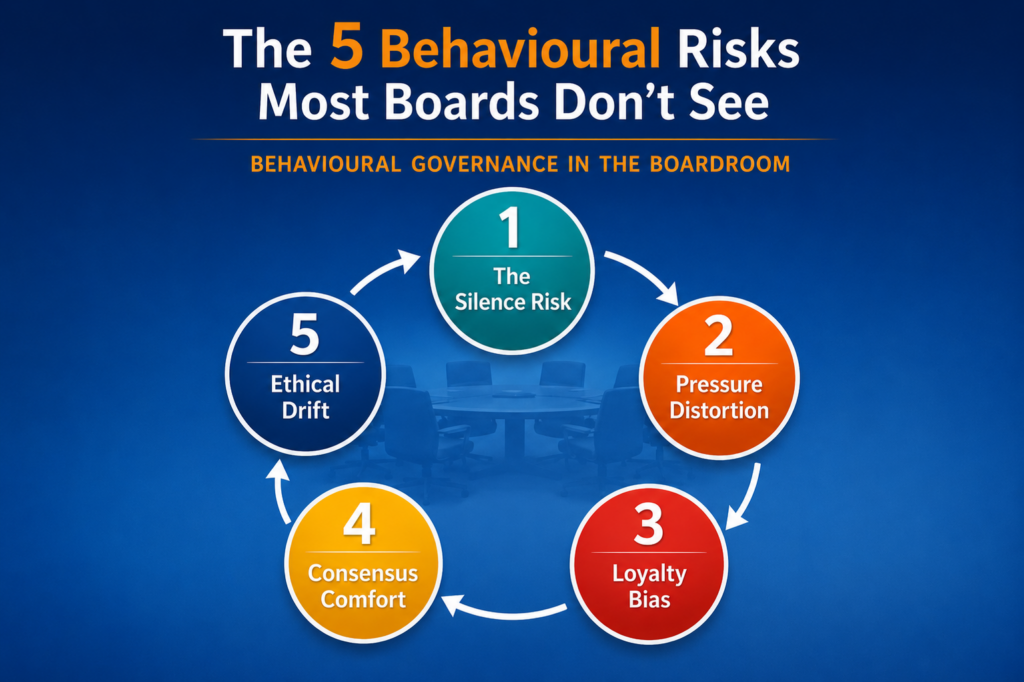
The following five behavioural risks are among the most common yet least recognised in boardrooms.
Behavioural Risk #1: The Silence Risk in Governance
One of the most dangerous behavioural risks in governance is silence.
In many organisations, warning signals appear long before governance failures become visible. Risk reports identify emerging concerns. Managers raise questions. Internal audits highlight gaps.
Yet those signals often fail to reach the board in their full form.
Why? Because speaking up can be uncomfortable. It can challenge authority, disrupt consensus, or create conflict. When organisational culture implicitly discourages difficult conversations, information becomes softened as it moves upward.
By the time issues reach the boardroom, they may appear less urgent or less severe than they truly are.
Boards that want to mitigate the silence risk must actively cultivate environments where uncomfortable information is welcomed rather than avoided. This requires more than open-door policies. It requires leadership behaviours that demonstrate psychological safety, curiosity, and a willingness to hear difficult truths.
When people believe their concerns will be taken seriously, silence begins to dissolve.
Behavioural Risk #2: Decision-Making Under Pressure
Under pressure, human judgement changes.
Deadlines tighten. Financial performance is under scrutiny. Stakeholders expect quick answers. In these moments, the quality of decision-making can quietly deteriorate.
Leaders may rationalise risks they would otherwise question. Ethical boundaries may be stretched in the name of expediency. Information that challenges a preferred outcome may receive less attention.
This phenomenon is not a reflection of poor character. It is a reflection of how pressure affects cognition and behaviour.
Boards often assume that governance frameworks will automatically protect decision-making during stressful periods. In reality, frameworks cannot prevent psychological pressure from influencing judgement.
Boards that understand this behavioural risk create space for reflection before critical decisions are made. They encourage dissenting perspectives, examine assumptions, and ensure that the pressure to deliver results does not quietly override ethical judgement.
The most effective boards recognise that good governance requires not only processes but also disciplined thinking under pressure. This is precisely where emotional intelligence becomes a governance capability, not just a leadership aspiration — the ability to recognise how pressure is distorting your own judgement in real time is one of the hardest and most important things a director can develop.
Behavioural Risk #3: Loyalty Bias in the Boardroom
In many organisations, loyalty is highly valued. Strong relationships between leaders can create trust, collaboration and stability.
However, loyalty can also introduce subtle governance risk.
When leaders work together for long periods, relationships deepen. Over time, questioning a colleague’s judgement can feel like questioning their integrity. Directors may hesitate to challenge management teams they respect. Executives may hesitate to escalate concerns that could reflect poorly on trusted colleagues.
This phenomenon is often invisible because it operates beneath conscious awareness.
Boards must recognise that healthy challenge is not disloyalty – it is a governance responsibility.
Effective boards establish norms where robust questioning is expected rather than avoided. Directors challenge ideas without attacking individuals. Management teams understand that scrutiny is a normal part of responsible oversight.
When loyalty is balanced with accountability, governance becomes stronger rather than more confrontational.
Behavioural Risk #4: Consensus Comfort and Groupthink
Boardrooms often value consensus. Agreement creates efficiency and stability, and it signals unity to stakeholders.
Yet consensus can also create governance vulnerability.
When a dominant narrative forms around a decision, dissenting voices may gradually fade. Directors who hold reservations may remain quiet to preserve harmony. Alternative perspectives may receive less attention as the group moves toward agreement.
In governance contexts, groupthink can lead to decisions that appear rational but have not been adequately challenged.
Boards that want to mitigate this risk deliberately design decision-making processes that invite challenge. Chairs can encourage directors to articulate alternative viewpoints. Boards can conduct “devil’s advocate” discussions or explore scenarios where assumptions prove wrong.
Healthy governance requires not only intelligent people around the table, but also decision environments that allow independent thinking to surface.
Behavioural Risk #5: Ethical Drift in Organisations
Perhaps the most subtle behavioural risk in governance is ethical drift.
Ethical failures rarely occur suddenly. More often, they emerge gradually through small compromises that appear insignificant at the time.
A reporting shortcut becomes normalised. A questionable transaction is rationalised as an exception. A minor compliance breach is treated as manageable.
Over time, these small decisions accumulate. The organisations ethical boundaries quietly shift, often without anyone consciously recognising the change.
Boards reviewing policies may see nothing unusual. Documentation appears intact. Compliance reports appear satisfactory.
Yet the behavioural norms within the organisation may have already shifted.
Preventing ethical drift requires boards to focus not only on formal compliance but also on organisational culture and behavioural signals.
- Boards should ask questions that go beyond metrics:
- How are ethical dilemmas discussed within the organisation?
- Do employees feel safe raising concerns?
- Are leaders rewarded only for results, or also for how those results are achieved?
Ethical cultures are not sustained by policies alone. They are sustained by consistent behavioural signals from leadership.
Many organisations only identify these behavioural risks when they undertake an independent board governance review designed to assess how governance actually functions in practice.
Regulators such as ASIC have repeatedly emphasised that governance failures often stem from leadership behaviour rather than the absence of policies.
From Awareness to Action — What Boards Can Do
Understanding these five risks is necessary. Acting on them is what separates boards that govern well from boards that govern adequately until something goes wrong.
Addressing behavioural risks does not require dismantling existing governance frameworks. It requires recognising that structure and behaviour must work together — and that structure, on its own, is insufficient.
The boards that navigate this most effectively share a common orientation. They do not ask only whether the right frameworks exist. They ask how people actually behave when those frameworks are tested. They treat psychological safety not as an HR aspiration but as a governance precondition — because a board that cannot hear uncomfortable information cannot exercise genuine oversight. They design for challenge rather than assuming it will happen naturally. And they hold themselves to the same standard of scrutiny they apply to management.
This is not a soft agenda. It is a governance imperative. Regulators have repeatedly made clear that governance failures stem from leadership behaviour — not the absence of policies. The Star Entertainment judgment is the most recent and most forensically detailed illustration of that finding. It will not be the last.
The Future of Governance Is Behavioural
As organisations face increasing complexity, governance expectations will continue to evolve. Regulators, stakeholders, and communities are demanding not just robust frameworks but demonstrable accountability — evidence that the people making governance decisions have the judgement, integrity, and behavioural capacity to govern when it matters most.
That demand will not be satisfied by another policy review or a revised risk appetite statement. It will be satisfied — or not — by how leaders behave when pressure rises, when loyalty is tested, and when speaking up carries a professional cost.
Governance systems rarely fail because policies are missing. They fail when human behaviour quietly overrides the intentions of those policies — and no one in the room asks why.
Boards that recognise this reality, and actively address the behavioural risks that structural frameworks cannot see, will be better equipped to navigate uncertainty, protect their organisations, and uphold the ethical standards that genuine governance demands.
Governance does not live in documents. It lives in how people choose to act when the stakes are high.
Behavioural risk rarely announces itself through policy breaches. More often, it appears in patterns of decision-making, challenge, escalation and accountability long before formal governance concerns emerge. Organisations seeking a structured assessment of these dynamics may benefit from an Independent Governance Review or Board Performance Review.
Sanela Osmic GAICD is the Founder and Principal of Ethical Governance. Her work focuses on behavioural governance, governance judgement and decision integrity. She is the developer of the Osmic Governance Architecture™ (OGA) and the author of Leading with Emotional Intelligence: A Guide for Board Directors.
Contact us for more details.
Very relevant and real. What is interesting is the fact that when operating may appear seamless and friction less, it’s important to see that it’s not disguised in favourable bias.
Hard facts have been very nicely summarised and would amply testify on each of the well known governance failure case .