
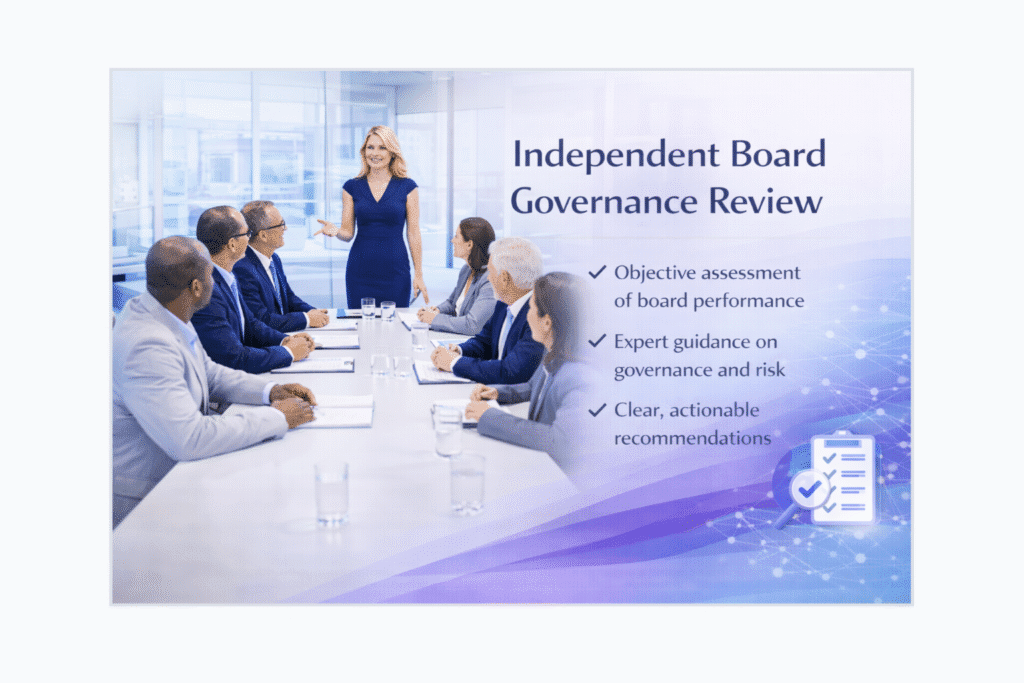
What is an Independent Governance Review?
An Independent Governance Review is a confidential, evidence-based assessment of governance practices, board decision-making, oversight and organisational culture conducted by an independent external adviser.
Independent Governance Reviews (sometimes referred to as governance assessments or governance investigations) provide boards with objective insight into governance concerns, oversight effectiveness and organisational decision-making.
How is a Governance Review different from a Board Performance Review?
A Board Performance Review evaluates the effectiveness of a board as part of normal governance practice and continuous improvement, with a particular focus on board performance, capability, decision-making and boardroom dynamics.
A Governance Review takes a broader organisational view, examining governance structures, accountability arrangements, decision-making processes, culture and oversight mechanisms across the organisation. While Governance Reviews are often commissioned following a governance concern, regulatory scrutiny or significant organisational event, they are equally valuable for boards seeking an independent assessment of governance effectiveness, governance maturity and overall governance health.
Many organisations undertake Governance Reviews proactively to take the pulse of their governance and identify opportunities for improvement before issues arise.
Why Boards Request an Independent Governance Review
Boards and organisations typically commission an Independent Governance Review when:
- The board or a significant stakeholder wants objective external assurance that governance is genuinely sound — not just structurally compliant
- A formal complaint or internal escalation has raised questions about board conduct or decision-making
- A regulatory body has initiated scrutiny or requested evidence of governance soundness
- A significant public or reputational incident has occurred and the board needs independent assessment of what happened
- A whistleblower disclosure has raised concerns that require independent examination
- A major leadership departure has occurred under circumstances that warrant scrutiny
- An organisation is preparing for a governance-sensitive transaction, merger, or restructure and needs independent verification of governance integrity
An independent governance review provides objective insight without internal bias.
A governance review is not an admission of weakness.
It is an act of stewardship.
What does a Governance Review examine?
Each review is structured, independent, and confidential.
It typically includes:
- Confidential director interviews
- Chair consultation
- Executive interface review
- Board paper and documentation analysis
- Committee effectiveness assessment
- Cultural and behavioural pattern evaluation
Findings are synthesised into a disciplined report with clear, practical recommendations – not abstract commentary.
Why Ethical Governance?
Unlike generic governance consulting, our approach integrates structural analysis with behavioural insight – recognising that governance failure often begins with culture, not policy.
An Ethical Governance review examines:
- Decision quality
- Oversight discipline
- Behavioural patterns
- Cultural risk signals
- The alignment between governance and organisational values
Outcomes Boards Typically Experience
Boards who undertake this process often report:
- Greater strategic clarity
- Stronger challenge culture
- Improved board paper quality
- Clearer role delineation between board and management
- More disciplined application of risk appetite
- Renewed confidence in governance processes
The objective is not critique.
It is clarity, alignment, and strengthened stewardship.
Confidential Governance Conversation
Independent governance reviews are undertaken discreetly.
Unlike traditional governance reviews, our approach incorporates behavioural governance factors such as decision-making, boardroom dynamics, challenge, escalation and Decision Integrity.
If your board is reflecting on effectiveness, culture, or oversight discipline, a confidential discussion may be the appropriate next step.
Book a Confidential Governance Conversation
For boards seeking a regular board performance review as part of disciplined governance practice, the Board Performance Review is the appropriate service.