
The Governance Risk That Doesn’t Appear in Risk Registers
Across sectors and jurisdictions, a consistent pattern emerges in governance failure.
Structural systems were not absent. Risk registers existed. Committees functioned. Compliance requirements were met.
Yet decision integrity deteriorated.
The variable that is rarely measured — and almost never named — is the emotional and behavioural climate in which governance decisions are made.
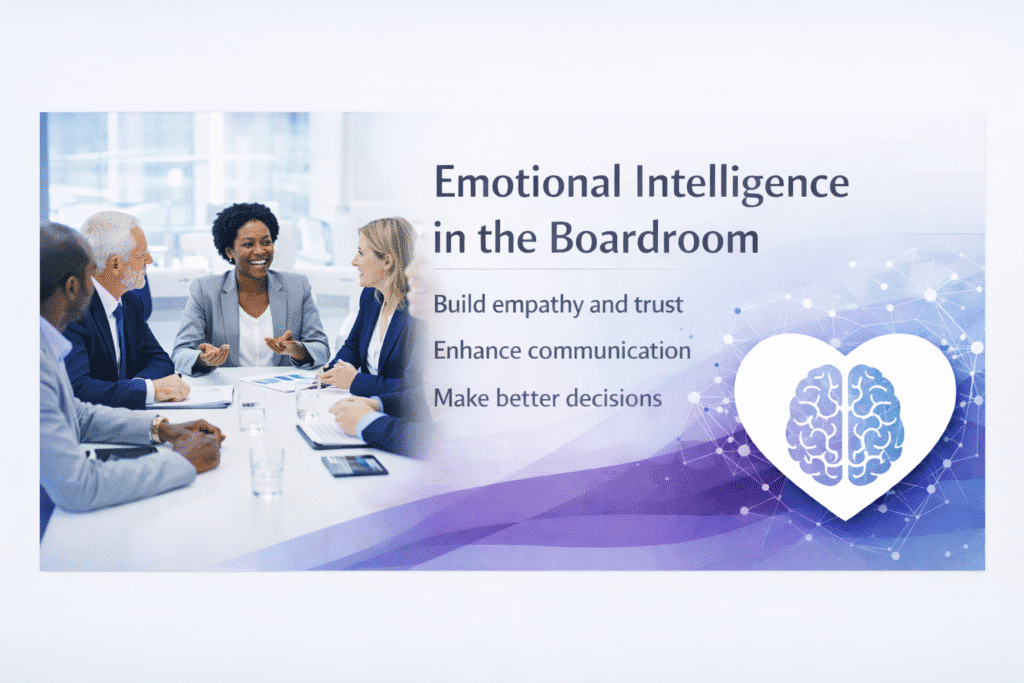
Emotional intelligence in the boardroom is not a leadership preference. It is a governance risk variable — one that determines whether structures, charters, and frameworks produce the decisions they were designed to produce, or whether they are bypassed, compromised, or hollowed out by the human dynamics operating beneath them.
When emotional dynamics go unexamined at board and executive level, they distort judgment, suppress dissent, enable ethical drift, and produce the conditions in which governance failure becomes not just possible but predictable.
From Leadership Theory to Governance Architecture
The institutional foundation for this work is set out in Leading with Emotional Intelligence: A Guide for Board Directors, which examines how emotional awareness, regulation, and ethical discipline shape board-level judgment — and why their absence produces predictable governance risk.
That research did not stop at leadership theory. It continued through a program of original empirical work examining documented governance failures across three countries, which established something the leadership literature had long suggested but never empirically demonstrated: that emotional and interpersonal deficits at board level are not background noise. They are primary drivers of governance failure — observable, escalating, and measurable before a failure becomes public.
This is the intellectual foundation that distinguishes our boardroom EI work. It is not drawn from generic leadership development frameworks. It is grounded in governance-specific research, applied to governance-specific contexts, and operationalised through a proprietary instrument — the Governance Architecture Diagnostic™ — designed specifically to assess the behavioural dimensions that determine governance quality.
That grounding matters. It means the work we do in boardrooms is not adapted from elsewhere. It was built for this environment, tested against evidence from real governance failures, and designed to produce governance outcomes — not just better leaders.
What we work on
Our boardroom EI work addresses the specific interpersonal and behavioural dynamics that shape governance quality in practice.
Emotional Intelligence for Directors — Strengthening the behavioural conditions that support sound judgement, constructive challenge, stakeholder awareness and decision integrity under pressure.
Conflict Resolution — Not all boardroom conflict is dysfunction. Some of the best governance decisions emerge from well-managed disagreement. We work with boards to distinguish productive challenge from destructive conflict, and to develop the interpersonal frameworks that allow difficult conversations to produce better decisions rather than suppressed ones.
CEO–Board Relationship — The relationship between the board and the CEO is the single most consequential interpersonal dynamic in any organisation’s governance system. When it works well — when there is honest exchange, mutual accountability, and clear boundaries — governance is strong. When it becomes deferential, defensive, or adversarial, governance deteriorates regardless of what the documents say. We work with both parties to build a relationship that serves the organisation rather than one that serves either party’s comfort.
Boardroom Dynamics — Dominant voices, silent directors, alliance patterns, and the unspoken hierarchy that shapes who influences decisions — these dynamics are present in every boardroom and are rarely named. We make them visible and workable, so that the board’s collective intelligence is genuinely available rather than structurally suppressed.
Why this matters beyond leadership development
Generic EI training asks: how emotionally intelligent are you as a leader?
Boardroom EI work asks a different question: how do the emotional and interpersonal dynamics in this room affect the quality and integrity of governance decisions?
That shift in framing is significant. It moves EI from a personal development concept into a governance risk concept. And it means that what we observe and develop in boards goes beyond individual competency — it reaches into the collective climate that either enables or compromises sound governance under pressure.
From development to measurement
Board development work strengthens the emotional and interpersonal capabilities that governance depends on. But development without measurement is incomplete — it cannot establish a baseline, identify where risk is concentrated, or track whether capability has genuinely improved.
The Governance Architecture Diagnostic™ is the instrument that takes this work to the next level. Grounded in the Osmic Governance Architecture™ and developed through original empirical research, it measures seven behavioural governance dimensions — including Emotional Regulation Under Pressure, Stakeholder Empathy & Societal Awareness, Courageous Accountability, and Power Awareness & Ego Management — producing a structured assessment of where your board’s behavioural governance capacity is strong, where it is at risk, and what needs to change.
If EI in the boardroom is the foundation, the Governance Architecture Diagnostic™ is the measure of whether that foundation is holding.