

There is a persistent assumption in governance that better structures produce better decisions. More robust risk frameworks. Clearer delegations. More rigorous audit programs. If the architecture is sound, the reasoning goes, the decisions will follow.
It is a reasonable assumption. It is also incomplete.
Because structures do not make decisions. People do. And when people make decisions — particularly under pressure, time constraints, uncertainty or the weight of a dominant view — what governs the quality of those decisions is not the policy framework in front of them. It is what is happening inside them.
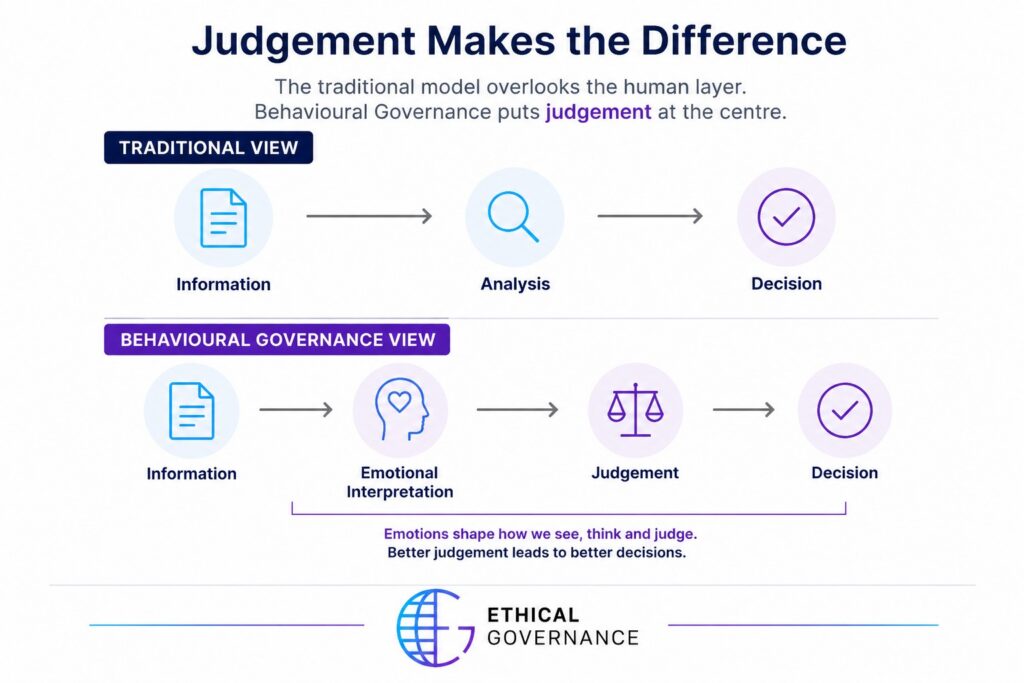
Governance is often described as a system of oversight, accountability and control. In practice, however, governance is fundamentally an exercise in judgement. Directors are rarely asked to choose between clearly right and clearly wrong options. More often, they must interpret incomplete information, weigh competing risks, reconcile competing stakeholder interests and make decisions under conditions of uncertainty. The quality of governance therefore depends not only on the structures surrounding decision-making, but on the quality of judgement applied within them.
This is where emotional intelligence becomes a governance question, not merely a leadership one.
What Kahneman Tells Us About Boards
In Thinking, Fast and Slow, Daniel Kahneman draws a distinction that is deceptively simple and profoundly consequential for anyone thinking seriously about governance.
System 1 thinking is fast. It is intuitive, pattern-driven and emotionally responsive. It operates below the threshold of conscious deliberation. It is how we navigate most of daily life — and how we respond when conditions are difficult, unfamiliar or threatening.
System 2 thinking is slow. It is deliberative, analytical and effortful. It is the kind of thinking governance frameworks presuppose — the careful weighing of information, the systematic assessment of risk, the considered application of judgement.
The problem is this: System 2 is not the default. It requires effort, time and the right conditions. When those conditions are absent — when a meeting is running long, when a Chair is signalling impatience, when a dominant colleague has already declared a position, when the pressure to reach consensus is palpable — System 1 takes over. Not because the director lacks intelligence or competence. Because that is how human cognition works.
The governance implications are uncomfortable. Board decisions — particularly those made under time pressure, uncertainty or strong social influence — are highly susceptible to System 1 dominance. Overconfidence. Anchoring to the first figure presented. Confirmation bias that leads directors to seek information validating what they already believe rather than genuinely testing it. The affect heuristic, where a director’s emotional response to a CEO they trust — or distrust — shapes their assessment of that person’s proposal.
These are not necessarily failures of character. They are often the predictable products of the cognitive architecture that all human beings share. And critically, structural governance frameworks — which presuppose deliberative, rational decision-making — were not designed to account for them.
Governance Integrity Is Tested Under Pressure
This is the tension at the heart of board decision-making. Governance integrity is rarely tested when conditions are stable, the information is clear and there is no pressure on the room.
It is tested when directors cannot agree on a course of action. The financial risks of proceeding are significant. The reputational risks of delaying are equally serious. Information is incomplete, stakeholder expectations are conflicting, and there is no option that is clearly right. In those moments, governance becomes an exercise in judgement.
In those moments, the question is not whether a director knows what good governance looks like. They do. The question is whether their emotional intelligence holds — whether they can recognise what is happening in the room and in themselves, manage their response, and act with integrity when the conditions are actively working against it.
A director whose self-awareness is underdeveloped will not notice that their enthusiasm for a proposal is partly shaped by their relationship with the person presenting it. A director who cannot regulate under pressure will default to compliance — saying less than they should, softening a concern that deserves to be raised directly, going along because the friction of dissenting feels too costly in the moment.
A board that lacks the collective emotional intelligence to name what is happening — the false consensus, the unspoken concern, the question no one is asking — will produce decisions that reflect the path of least resistance rather than the quality of its deliberation.
What EI Actually Does in a Governance Context
Emotional intelligence in governance is not about being warm, empathetic or emotionally expressive. It is a set of practised capacities that determine whether a director’s judgement holds in the conditions governance actually creates.
- Self-awareness is what allows a director to notice, in the moment, that their response to a risk briefing is being shaped by their history with the executive presenting it — not just the merits of the analysis. Without it, the bias operates invisibly, influencing the decision without the director’s knowledge.
- Self-regulation is what allows a director to maintain the quality of their questions when the Chair has signalled that the item should be wrapped up. It is the capacity to hold a concern even when the room has moved on, and to name it before the vote rather than in the corridor afterwards.
- Empathy is what allows a board to actually understand what a stakeholder group is telling them — not the version that makes approval easy, but the version that is true. A board without empathy can consult extensively, document carefully, and still make decisions that bear no meaningful relationship to the realities of the people most affected.
- Social intelligence is what allows a director to read the room accurately — to see the false consensus forming, to notice who is holding back, to name the dynamic before it produces an outcome no one individually endorsed.
Taken together, these capacities determine not just how individual directors behave, but what kind of board culture is possible. Because board culture is not a separate thing from the emotional intelligence of the directors in the room. It is the accumulation of it — expressed through what gets challenged, what gets tolerated, what gets named and what gets quietly decided before anyone arrives at the table.
The Trainable Dimension
There is encouraging evidence in the research literature that bias awareness is trainable — that structured deliberative interventions reduce the incidence of predictable governance decision errors. This matters. It means that the cognitive vulnerabilities Kahneman identified are not fixed features of individual directors. They are patterns that can be recognised, examined and — with practice — interrupted.
This is the purpose of developing EI as a governance capability rather than treating it as a personality trait some directors happen to have. The director who can catch the affect heuristic operating in real time — who can notice that their enthusiasm for a proposal is partly a function of their relationship with the CEO rather than the quality of the analysis — is in a fundamentally different position from one who only recognises it in retrospect.
The development of that capacity is not a soft leadership exercise. It is a governance intervention with direct consequences for decision quality.
While emotional intelligence is often discussed as a way of reducing bias, its governance significance runs deeper. Directors do not encounter organisational reality directly. They interpret information through experience, assumptions, relationships and emotional responses. The quality of governance therefore depends not only on the information available, but on the quality of judgement applied to that information. Understanding how emotion shapes judgement may be one of the next frontiers in governance thinking.
The Governance Question That Matters
In the end, this brings us back to a question that structural governance frameworks cannot answer on their own: what will a director actually do when the conditions are difficult and the cost of acting is real?
When the room has moved. When raising the concern will create friction, and silence feels easier. In that moment — not in the governance manual, not in the terms of reference, not in the risk framework — what holds?
The answer is the director’s emotional intelligence. Their capacity to see clearly, to regulate under pressure, to act with integrity when it costs something.
That capacity can be developed. It needs to be. Because governance integrity is not demonstrated in stable conditions. It is demonstrated under pressure — and that is precisely when EI either holds or gives way.
The quality of governance is ultimately reflected in the quality of decisions made under pressure. Understanding the role emotional intelligence plays in boardroom judgement is the first step. Assessing how these dynamics operate within your own board is the next. Ethical Governance provides Board Performance Reviews, Governance Reviews and Emotional Intelligence in the Boardroom programs designed to strengthen decision integrity where it matters most.
Sanela Osmic GAICD is the Founder and Principal of Ethical Governance. Her work focuses on behavioural governance, governance judgement and decision integrity. She is the developer of the Osmic Governance Architecture™ (OGA) and the author of Leading with Emotional Intelligence: A Guide for Board Directors.
Comments