
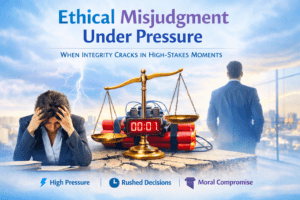
Why Governance Fails When It Matters Most
Most leaders, boards, and executive teams appear ethical when conditions are stable.
When performance is strong, stakeholder expectations are manageable, and difficult trade-offs are absent, ethical conduct often seems straightforward. Policies are followed, governance frameworks function as intended, and organisational values are comfortably reinforced through annual reports, strategic plans, and corporate communications.
The true test of ethical governance, however, does not occur in periods of stability.
It occurs when organisations come under pressure.
Ethics is tested when revenue declines and difficult financial decisions become unavoidable. It is tested when regulators begin asking uncomfortable questions, when media scrutiny intensifies, when stakeholder interests collide, and when leaders are forced to choose between short-term organisational interests and longer-term principles. Most importantly, it is tested when personal reputations, authority, and status feel threatened.
It is in these moments — not during governance workshops, strategic planning sessions, or routine compliance reviews — that ethical misjudgment emerges.
Contrary to popular belief, major governance failures rarely originate from ignorance or incompetence. In many cases, the individuals involved are highly experienced, well-intentioned, and genuinely committed to organisational success. What distinguishes governance failures from governance success is often not the quality of the framework itself, but the quality of judgement exercised under pressure.
The Illusion of Ethical Stability
Many organisations assume they are ethically resilient because they have invested heavily in governance infrastructure. They have codes of conduct, risk management frameworks, whistleblower policies, delegated authorities, governance charters, and compliance programs. These mechanisms are important and provide essential safeguards against misconduct.
However, the presence of governance structures should not be confused with the presence of ethical resilience.
Governance frameworks establish expectations, but they do not determine how individuals will behave when confronted with competing pressures, uncertainty, fear, or personal risk. Behavioural integrity cannot be documented into existence.
Ethical misjudgment rarely begins with a dramatic departure from organisational values. More often, it begins through a series of seemingly minor compromises. A decision is rushed because commercial pressures demand speed. A dissenting perspective is dismissed as impractical or disruptive. A risk is reframed as unlikely to materialise. A concern is deferred because the timing is inconvenient. A compromise is justified as temporary and therefore harmless.
Individually, these decisions appear insignificant. Collectively, they create the conditions for ethical drift.
Governance failures are rarely the result of a single catastrophic decision. They are more commonly the outcome of a gradual accumulation of small compromises that progressively move decision-makers away from their stated principles.
Pressure Changes How We Think
One of the most overlooked dimensions of governance is the impact of pressure on human judgement.
When individuals perceive threat—whether financial, reputational, political, or interpersonal — the human nervous system responds in predictable ways. Attention narrows, threat sensitivity increases, and cognitive resources become focused on immediate problem-solving rather than reflective analysis. The brain prioritises speed and certainty at precisely the moment when careful deliberation is most needed.
Within governance settings, these physiological responses often manifest as a heightened sense of urgency, reduced tolerance for ambiguity, increased defensiveness, and a preference for simple explanations to complex problems. Decisions that would normally attract rigorous challenge may pass with limited scrutiny because the pressure to act overrides the discipline to reflect.
This creates an important governance paradox. The situations that require the greatest degree of ethical clarity are often the situations in which ethical clarity becomes most difficult to access.
Without conscious self-regulation, leaders naturally default to instinctive responses. Under pressure, those responses are frequently driven by self-protection rather than principle. The desire to preserve reputation, maintain authority, avoid criticism, or protect organisational interests can subtly distort judgement long before decision-makers recognise what is occurring.
For this reason, ethical governance cannot be understood solely as a matter of structures and processes. It must also be understood as a behavioural discipline that requires leaders to manage their own psychological responses under pressure.
The Three Patterns of Ethical Drift
Ethical misjudgment rarely begins with deliberate misconduct. Instead, it tends to emerge through predictable behavioural patterns that gradually weaken decision integrity.
1. Normalization of Deviation
Small exceptions become accepted practice, often justified by precedent, commercial necessity, or industry norms. Over time, behaviours that would once have attracted concern become viewed as routine.
“We’ve done this before.”
“This is how the industry operates.”
“It’s technically compliant.”
When standards slowly lower, no single decision appears catastrophic.
But governance failure is rarely one decision.
It is a pattern of tolerated deviation.
2. Emotional Contagion at the Top
Boards and executive teams are not purely rational human beings; they are emotional beings as well. The emotional state of influential leaders significantly shapes the behaviour of those around them. When a Chair becomes defensive, others may become reluctant to challenge.
When a CEO displays anxiety, urgency often spreads throughout the executive team. When influential decision-makers downplay risk, others frequently follow.
Emotions travel quickly through groups, often influencing judgement before logic has an opportunity to intervene.
If the emotional tone at the top is fear, urgency, or ego-protection, ethical judgment is already compromised.
3. Moral Licensing
This is one of the most dangerous forms of ethical drift. It occurs when past ethical behaviour becomes an unconscious justification for present compromise. Organisations with strong reputations are particularly vulnerable to this dynamic. Leaders begin to believe that because the organisation has historically acted responsibly, a small departure from principles can be justified in pursuit of a greater good.
Yet integrity does not operate like a bank account where previous good behaviour accumulates credits for future withdrawals. Ethical conduct must be continually renewed through present decisions.
Why Intelligence Is Not Enough
Many governance failures occur in rooms filled with highly intelligent people.
The individuals involved are often accomplished leaders with impressive credentials, decades of experience, and strong professional reputations. They understand governance principles, can interpret complex information, and possess deep industry expertise. Yet governance failures continue to occur in organisations led by highly capable people.
This is because intelligence alone does not protect against ethical misjudgment.
Degrees do not prevent ethical drift. Experience does not guarantee restraint. Reputation does not automatically translate into self-awareness.
What is often missing is not knowledge — it is emotional regulation.
Under pressure, leaders are required to manage powerful psychological forces. Fear of reputational damage, anxiety about financial outcomes, the desire to maintain authority, sensitivity to criticism, and the need for peer approval can all influence judgement in subtle but significant ways.
Without the ability to recognise and regulate these emotional responses, decision-making becomes vulnerable to distortion. Risks may be minimised, concerns rationalised, and principles compromised in pursuit of short-term relief.
Ethical misjudgment is rarely a failure of intelligence.
More often, it is a failure of emotional integrity — the ability to remain aligned with one’s values when pressure encourages otherwise.
The Silence That Costs Millions
Some of the most expensive governance failures are not caused by what is said in the boardroom.
They are caused by what remains unsaid.
As pressure increases, dissent often decreases. Directors become more cautious in raising concerns. Executives soften objections to avoid conflict. Difficult questions go unasked. Alternative perspectives remain unspoken.
This phenomenon is rarely the result of deliberate negligence. Rather, it reflects the natural impact of hierarchy and pressure on human behaviour.
When stakes are high, challenging influential individuals becomes psychologically more difficult. The stronger the personality in the room, the greater the pressure others may feel to conform. Over time, this creates an environment where apparent agreement masks unexpressed concerns.
This is why psychological safety is so critical to effective governance.
Boards that encourage challenge, inquiry, and constructive dissent are more likely to identify risks before they escalate. Boards that unintentionally discourage disagreement create conditions where silence becomes normalised.
Silence is often the first indicator of ethical vulnerability.
Unfortunately, by the time that silence becomes visible, the consequences may already be unfolding.
The Cost of Rushed Decisions
Almost every major governance crisis contains a defining moment — a point at which decision quality deteriorated under the weight of urgency.
A decision was accelerated.
Critical reflection was abbreviated.
Stakeholder implications were not fully explored.
Someone in the room insisted there was not enough time.
The language of urgency is one of the most powerful forces affecting governance judgement.
When organisations face commercial, regulatory, or reputational pressure, speed often becomes confused with effectiveness. Leaders may feel compelled to act quickly to demonstrate decisiveness, even when the circumstances require deeper analysis.
Yet reflection is not indecision.
It is strategic restraint.
The ability to pause, challenge assumptions, test alternative scenarios, and consider longer-term consequences often determines whether governance succeeds or fails.
In high-pressure environments, slowing down is not a sign of weakness.
It is a sign of discipline.
The cost of delaying a decision for further consideration is frequently negligible. The cost of making the wrong decision under pressure can be catastrophic.
Structural Safeguards Are Not Enough
When organisations experience governance failures, the instinctive response is often to strengthen controls.
Additional policies are introduced. New approval processes are implemented. Reporting requirements increase. More oversight mechanisms are added.
While these responses may be necessary, they often fail to address the underlying causes of ethical misjudgment.
Governance failures are not always structural failures.
Many are behavioural failures.
Additional controls cannot compensate for poor judgement, unmanaged emotions, or cultures that discourage challenge. A board can possess exemplary governance documentation and still make poor decisions if the behavioural conditions necessary for sound judgement are absent.
True ethical resilience requires more than compliance.
It requires self-aware leadership, emotional regulation under pressure, clear behavioural expectations, disciplined decision-making processes, and a culture that actively encourages constructive dissent.
Without these elements, governance structures risk becoming performative rather than protective.
Governance architecture must be supported by psychological architecture.
Otherwise, the structures designed to protect decision quality may collapse precisely when they are needed most.
Building Ethical Resilience Under Pressure
Ethical integrity is not built during a crisis.
It is built long before a crisis occurs.
The organisations that navigate pressure most effectively are those that deliberately cultivate the behavioural capabilities required to maintain sound judgement under stress.
The first of these capabilities is self-awareness. Leaders must understand how pressure affects their own thinking and behaviour. Defensiveness, impatience, overconfidence, avoidance, and risk denial are common stress responses that can undermine decision quality if left unchecked.
The second capability is emotional regulation. Effective leaders develop the ability to pause before reacting, separate emotion from analysis, and maintain composure during difficult discussions. This helps stabilise group dynamics and improve collective judgement.
The third capability is the establishment of clear boundaries. Organisations need clearly defined principles, escalation protocols, and non-negotiable standards that remain intact even when commercial pressures intensify. Pressure inevitably tests boundaries. If they are not established in advance, they often dissolve when challenged.
The fourth capability is discipline. This includes the discipline to seek additional information, delay premature decisions, encourage dissenting views, and remain committed to principles even when doing so is inconvenient.
Together, these capabilities form the foundation of ethical resilience.
When Pressure Reveals Character
Pressure does not create character.
It reveals it.
When financial, political, regulatory, or reputational stakes increase, leaders often revert to their underlying behavioural patterns. The habits, values, and disciplines developed over time become visible in decision-making.
If those foundations are built on fear, ego, defensiveness, or self-protection, ethical misjudgment becomes more likely.
If they are built on self-awareness, courage, humility, and discipline, integrity is more likely to hold.
This is why ethical governance cannot rely solely on compliance frameworks, policies, and procedures.
It must also cultivate emotionally intelligent leadership.
Policies cannot regulate fear.
Frameworks cannot regulate ego.
Procedures cannot regulate anxiety.
Only people can do that.
And the quality of governance ultimately depends upon the quality of the people exercising it.
The Real Risk
The greatest governance risk is not usually corruption.
It is rationalisation.
It is the subtle process through which individuals convince themselves that a compromise is reasonable, temporary, or necessary.
It is the statement that has preceded countless governance failures:
“It’s just this once.”
Rarely does ethical misjudgment feel unethical in the moment. More often, it feels justified. It feels practical. It feels necessary.
That is precisely what makes it dangerous.
Preventing ethical misjudgment therefore requires more than good intentions. It requires deliberate systems that encourage reflection, support challenge, reinforce accountability, and strengthen emotional discipline throughout the organisation.
Final Reflection
The true test of governance is not what happens when conditions are favourable.
It is what happens when time compresses, scrutiny intensifies, emotions escalate, and the consequences of decisions feel immediate.
In those moments, integrity is not a statement of values.
It is a behavioural choice.
It is the discipline to pause when others want to rush.
It is the courage to challenge when others remain silent.
It is the restraint to prioritise principle over convenience.
And often, it is that single moment of self-mastery that determines whether an organisation emerges stronger — or spends years recovering from preventable damage.
At Ethical Governance, help boards and executive teams strengthen decision integrity, improve behavioural governance, and build the leadership disciplines required to make sound decisions under pressure.
Because governance matters most when the pressure is highest.
Connect with us to strengthen your board’s decision integrity and ensure leadership remains steady, principled, and clear under pressure.
Sanela Osmic GAICD is the Founder of Ethical Governance and the developer of the Osmic Governance Architecture™ and the Governance Architecture Diagnostic™. The GAD is available for individual director assessments and full board engagements. Contact us for more details.
Comments