

Every governance failure leaves behind the same unanswered question.
“How did intelligent, experienced and well-intentioned people make a decision that ultimately betrayed what they believed to be right?”
After every corporate collapse, regulatory investigation or public inquiry, organisations review their governance frameworks, commission independent reports and strengthen their controls. New policies are introduced. Risk registers are updated. Additional oversight is established.
Yet the same pattern continues.
Organisations with experienced boards, sophisticated governance frameworks and robust risk processes continue to make decisions that damage trust, destroy value and undermine their own purpose.
Perhaps the problem isn’t that we lack governance.
Perhaps it’s that we’ve been measuring the wrong thing.
We evaluate decisions by their outcomes. We celebrate successful decisions. We criticise unsuccessful ones. But outcomes are an imperfect measure of decision-making.
A decision that remained faithful to what the organisation genuinely believed to be right can still produce a poor outcome, because markets change, new information emerges or circumstances evolve unexpectedly. Equally, a decision that drifted away from that alignment can still produce an excellent outcome, simply because the organisation got lucky.
Outcomes tell us what happened. They do not necessarily tell us whether the decision itself deserved to succeed.
That distinction matters. Because organisations don’t fail only because they make bad decisions. They fail because they gradually lose alignment between what they genuinely believe to be right and the decisions they ultimately make.
This Is What I Call Decision Integrity
Integrity, in its original sense, means wholeness — remaining whole, true to what something was intended to be. A decision has integrity when it remains whole: when what was decided still matches what the organisation genuinely believed to be right.
Decision Integrity is the extent to which a decision remains faithfully aligned with independent judgement despite competing behavioural pressures.
Independent judgement is not formed in isolation. It is informed by the organisation’s purpose, values, principles, available evidence, ethical reasoning and governance obligations. Decision Integrity is therefore about preserving alignment between judgement and decision — not allowing that alignment to be broken by fear, incentives, loyalty or other behavioural pressures.
That definition is deliberately different from decision quality.
|
Decision Quality Asks “Was this a good decision?” |
Decision Integrity Asks “Did this decision remain aligned with what the organisation genuinely stood for and believed to be right?” |
Those are not the same question.
A decision can remain fully aligned with sound judgement and still produce an unfavourable outcome. Conversely, a successful outcome does not prove that alignment was ever there.
This distinction changes how we think about governance.
Every important decision is subjected to pressure. Very few decisions are made in ideal circumstances.
Common Pressures on Judgement
None of these automatically produce poor decisions. What matters is whether they begin to pull the decision away from what was genuinely believed to be right. The moment external pressure starts breaking the alignment between judgement and decision, Decision Integrity begins to erode.
Not because people become unethical. But because they gradually stop deciding according to what they genuinely believe to be right.
Decision Integrity itself cannot be observed directly. It becomes visible only through behaviour. Behaviour is therefore not the problem governance seeks to manage — it is the evidence that reveals whether integrity between judgement and decision has been preserved.
Every decision eventually becomes behaviour. Every behaviour eventually produces an outcome. Which means behaviour provides evidence of something much deeper: whether alignment between judgement and decision was preserved, or quietly lost.
This is why repeated behavioural failures rarely begin as behavioural problems. They begin as failures of alignment.
Most Governance Failures Are Not Structural Failures
When organisations experience significant governance failures, the instinct is to redesign governance architecture. New committees. Additional reporting. Revised delegations. Updated frameworks.
These improvements may be necessary. But they often treat the symptom rather than the cause.
The more important question is whether those structures enable decisions to remain aligned with independent judgement when it matters most.
Because governance does not make decisions. People do. Structures influence judgement. They cannot replace it.
Decision Integrity ultimately reveals itself through behaviour.
Within Behavioural Governance, Decision Integrity is the desired governance outcome. Governance structures, leadership character and strategic judgement exist for different purposes, but they converge on one objective: preserving the integrity of organisational decisions. Decision Integrity is therefore not another governance principle; it is the measure of whether governance has achieved its purpose.
A board can possess exemplary governance documentation while repeatedly producing decisions that fail to remain aligned with its collective judgement.
Likewise, organisations with relatively simple governance arrangements may consistently demonstrate remarkable Decision Integrity because leaders remain willing to confront uncomfortable evidence, challenge assumptions and act according to principle rather than pressure.
Decision Integrity therefore cannot be found in policies. It reveals itself only through decisions.
The Decision Integrity Model
Decision Integrity sits at the centre of the sequence — the point where purpose and judgement either survive the pressure of a real decision, or quietly give way to it.
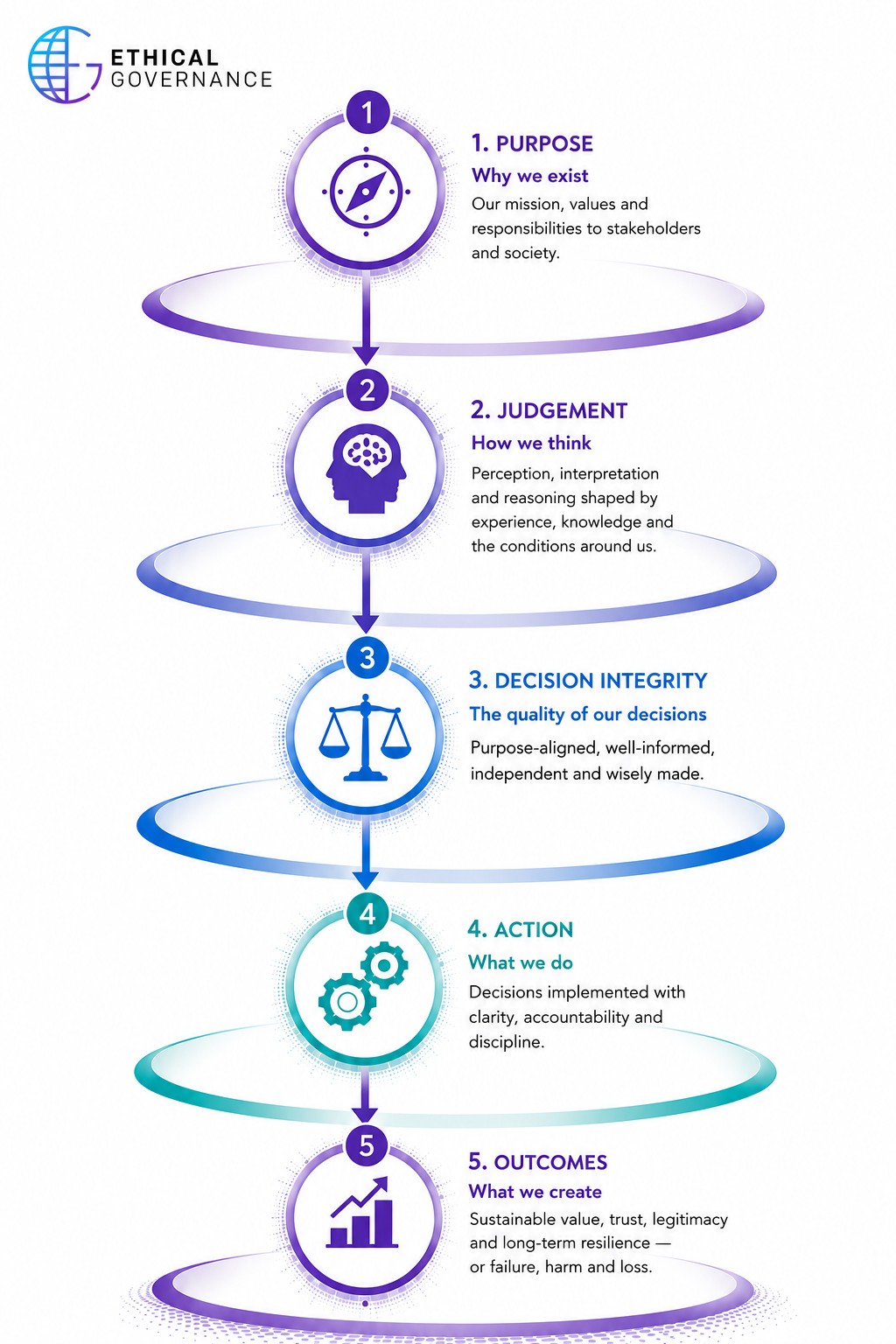
The Decision Integrity Model
The Question Boards Should Ask
After every significant decision, boards usually ask: “Did it work?”
A more valuable question may be: “Did this decision remain aligned with what the organisation genuinely stood for and believed to be right?”
Not the right question
- “Was everyone supportive?”
- “Was the process compliant?”
- “Did we achieve the desired outcome?”
The right question
“If fear, incentives, politics and external pressure had all disappeared, would we still have made the same decision?”
That single question exposes something many governance reviews overlook: whether the decision remained aligned with the organisation’s judgement… or drifted toward its pressures instead.
A New Standard for Governance
For decades, governance has concentrated on improving decision-making through better structures, clearer accountability and stronger oversight. These remain essential.
But governance ultimately exists for one purpose: to preserve the integrity of organisational decisions by ensuring they remain faithful to independent judgement, informed by purpose, values and principle.
Because every framework, committee, policy and control exists to support one moment — the moment someone decides.
And when that decision no longer aligns with the organisation’s judgement and purpose, governance has already begun to fail, regardless of how sophisticated its structures appear.
The organisations that will be trusted in the future will not simply be those with the strongest governance frameworks.
They will be those that consistently demonstrate Decision Integrity – the capacity to make decisions that remain aligned with sound judgement and genuine purpose, even when every pressure encourages otherwise.
If your board is grappling with difficult decisions or cultural blind spots, contact us to see how Ethical Governance can help.
Where Does Your Board Stand?
A short diagnostic to understand how much of your board’s judgement survives contact with real pressure.
Sanela Osmic GAICD is the Founder and Principal of Ethical Governance. Her work focuses on behavioural governance, governance judgement, and decision integrity. She is the developer of the Osmic Governance Architecture™ (OGA) and the author of Leading with Emotional Intelligence: A Guide for Board Directors.
If this article was useful to you, please share it with a colleague or board member, and leave a comment below. You can also subscribe to our newsletter — to receive new articles, governance insights, and research updates directly to your inbox.
Continue Exploring Behavioural Governance
If you found this article valuable, you may also be interested in:
Applying These Insights in Practice
Ethical Governance works with boards and executive teams to strengthen governance through:
Comments