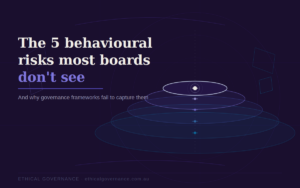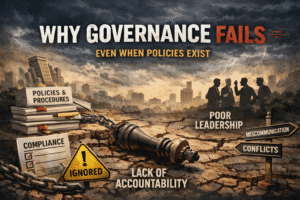

The 5 Behavioural Risks Most Boards Don't See — Ethical Governance A dark editorial graphic with a deep navy background. Five layered elliptical planes in graduating shades of purple and cyan recede into the centre-right of the image, representing hidden behavioural governance risks beneath the visible surface of formal structure. A single white dot marks the surface layer, with smaller coloured dots descending through each hidden layer. Abstract geometric shapes accent the left and right edges. On the left, large serif text reads "The 5 behavioural risks most boards don't see" in white and purple, with the subtitle "And why governance frameworks fail to capture them" below. The Ethical Governance name and website appear at the bottom in muted text.

The 5 Behavioural Risks Most Boards Don’t See

By sanelaosmic
on
in Categories Uncategorized

Why Governance Failures Are Often Behavioural, Not Structural Behavioural governance focuses on the human dynamics that influence decision-making in organisations. Boards invest significant time designing governance frameworks, risk committees and reporting structures, yet governance failures continue to occur across sectors. The reason is rarely structural. In many cases, the systems exist, policies are documented and

Read more...

Budgets, Broken Promises and Behavioural Governance

By sanelaosmic
on
in Categories Uncategorized

federal budget 2026, NDIS cuts 2026, behavioural governance, purpose drift, institutional accountability Australia, NDIS reform Sanela Osmic GAICD 2026-05-13 13 May 2026  •  Ethical Governance Pty Ltd Fiscal Discipline or Purpose Drift? Budgets are governance documents. Not only economic ones. Every federal budget reveals something about how an institution makes decisions under pressure — whose

Read more...
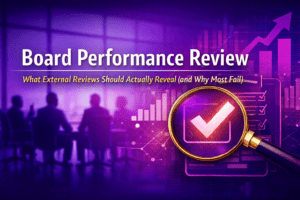
Board performance review banner showing a boardroom scene with silhouetted directors, data charts, and a magnifying glass highlighting governance evaluation and decision analysis in purple and blue tones.

Board Performance Review: What External Reviews Should Actually Reveal (and Why Most Fail)

By sanelaosmic
on
in Categories Uncategorized

Every year, boards undertake a board performance review. Most complete the process. Few gain insights that meaningfully improve how they govern. This is not a failure of intent. It is a failure of methodology. A typical external board review—a survey, followed by a debrief and a set of recommendations—captures what directors think about their board.

Read more...
director independence governance post image

“Independent” Is Not a Status. It’s a Behaviour.

By sanelaosmic
on
in Categories Uncategorized

Why director independence governance frameworks may be measuring the wrong thing— and what boards should be asking instead. Every year, thousands of directors tick the independence box. No material financial relationship with the organisation. No close family ties to management. Tenure within acceptable limits. Declaration lodged. Governance requirement met. And yet boards keep failing in

Read more...

After the Star Judgment: What Should Your Board Actually Do?

By sanelaosmic
on
in Categories Uncategorized

The Federal Court’s liability judgment in ASIC v Bekier has prompted more direct questions from governance practitioners and board members than any case I can recall in recent years. The question I have heard most consistently is not about the legal implications — good governance lawyers are across those. It is a more uncomfortable question.

Read more...
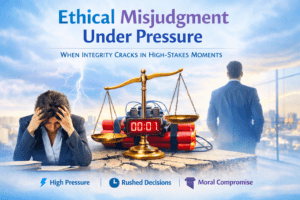
Header image for article titled “Ethical Misjudgment Under Pressure” in brand blue (#2fc5f4) and purple (#6e4d9f) tones. A stressed businesswoman sits at a desk on the left, while golden scales of justice balance beside a ticking digital timer and red dynamite in the centre, symbolising high-stakes decision-making. On the right, a suited executive stands facing a city skyline, representing leadership under pressure. The background is light with storm clouds and subtle lightning, illustrating tension, urgency, and moral compromise.

Ethical Misjudgment Under Pressure

By sanelaosmic
on
in Categories Uncategorized

Why Governance Fails When It Matters Most Most leaders, boards, and executive teams appear ethical when conditions are stable. When performance is strong, stakeholder expectations are manageable, and difficult trade-offs are absent, ethical conduct often seems straightforward. Policies are followed, governance frameworks function as intended, and organisational values are comfortably reinforced through annual reports, strategic

Read more...

Why Governance Fails – Even When Policies Exist

By sanelaosmic
on
in Categories Uncategorized

Understanding Governance Failure in Modern Boards Organisations invest heavily in governance frameworks. They build policies, establish charters, form committees, create risk registers, and conduct compliance audits. On paper, governance appears robust. Yet governance failure still happens. Boards collapse. Reputations deteriorate. Ethical misjudgments surface. Strategic decisions unravel under scrutiny. This raises a fundamental question: Why does

Read more...

Ethical Governance in Boards: Moving Beyond Compliance to Character

By sanelaosmic
on
in Categories Uncategorized

Ethical governance is often spoken about in aspirational terms – integrity, transparency, accountability. Yet in boardrooms, it is tested in far more practical and uncomfortable ways: in how decisions are made under pressure, how dissent is handled, how conflicts are declared, how risks are framed, and how silence is interpreted. Ethical governance in boards is

Read more...

Why Ethical Governance Is a Risk Management Issue (Not a Soft Skill)

By sanelaosmic
on
in Categories Uncategorized

For many organisations, ethical governance is still framed as a “values conversation” — important, but secondary to strategy, financial performance, and risk controls. It is often positioned as cultural, aspirational, or even soft. This framing is outdated — and increasingly dangerous. In reality, ethical governance is one of the most critical risk management capabilities an

Read more...

Why Governance Needs Heart: The Case for Emotionally Intelligent Boards

By sanelaosmic
on
in Categories Uncategorized

There is an assumption in governance that good decisions are purely rational: numbers, risk matrices, strategy maps. But organisations are not machines – they are made of people. And people bring histories, fears, loyalties, and hopes into boardrooms. If boards want to steward organisations that are resilient, ethical and genuinely high-performing, they must pair sharp

Read more...