
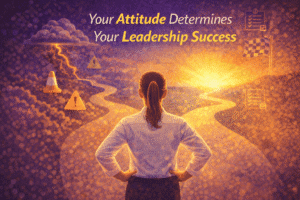
Success is a goal that virtually everyone aspires to achieve, but what truly sets successful individuals apart from the rest of the pack? Is it talent, luck, or a combination of factors that are beyond our control? While these factors can undoubtedly influence the path to success, one element stands out as a significant determinant: your attitude.
Your attitude, the lens through which you perceive the world and approach challenges, plays an integral role in determining your level of success.
Your attitude shapes how you interpret everything that happens to you.
And interpretation shapes your direction.
Two people can experience the same setback.
One sees failure.
The other sees feedback.
Two people can receive criticism.
One feels attacked.
The other feels stretched.
Two people can face uncertainty.
One feels threatened.
The other feels challenged.
The difference is not intelligence.
It’s attitude.
“People may hear your words, but they feel your attitude.“
John C. Maxwell
Attitude is the one thing all human beings have complete control of and yet many unknowingly choose a negative attitude. If we understood the power of our own attitude in our lives, most of us would change it immediately. How many times have you been told to change your attitude? That is a common order from most parents and teachers!
Life does not hand us neatly packaged circumstances. It hands us complexity.
Rejection.
Unexpected change.
Disappointment.
Pressure.
Success that feels fragile.
Responsibility that feels heavy.
Your attitude determines whether you experience these moments as:
- Proof you are not good enough
or - Evidence that you are growing.
It determines whether you believe the world is happening to you or whether it is shaping you for something greater.
Attitude is not blind positivity.
It is the decision to frame events in a way that empowers rather than diminishes you.
“Your attitude, not your aptitude will determine your altitude.”
Zig Ziglar
Attitude is created by your thoughts, feelings and actions. Your mind controls feelings and decides whether these feelings will be positive or negative through our thoughts. Your body then follows these thoughts through actions and behaviors. It sounds simplistic because it is.
Through our thoughts, we create an attitude. This attitude is expressed based on how we internalize ideas. Our mind and body move into a new vibration of conscious awareness known as feelings. These feelings are then displayed through actions and behaviors that produce the results in our lives.
Attitude [Thoughts + Feelings + Actions] = Results
Imagine feeding our minds with positive thoughts and flow through the process. We will end with positive results. Now imagine feeding our minds with negative thoughts and flow through the process. Makes sense, doesn’t it?
By changing our thoughts, we can change our attitude, which will ultimately change our results. Attitude is the creative cycle that allows us to feel a certain way and then take the necessary action to a specific result.
Before success is visible externally, it forms internally. The person who believes:
“I can learn this.”
“I can adapt.”
“This is temporary.”
“I am capable of more.”
…moves differently through life.
They take risks.
They try again.
They ask questions.
They recover faster.
The person who believes:
“This always happens to me.”
“I’m not built for this.”
“Other people are luckier.”
…shrinks their own horizon.
Attitude quietly defines what you believe is possible for you.
And what you believe is possible determines what you attempt.
Attitude Shapes Resilience
There are seasons in life where nothing feels easy. Moments where effort does not immediately translate into reward.
Moments where doubt becomes louder than confidence.
In those moments, attitude is not decorative – it is survival.
A resilient attitude does not deny difficulty.
It says:
“This is hard – and I will grow through it.”
It allows you to separate circumstance from identity.
You are not your failure.
You are not your mistake.
You are not your temporary setback.
Attitude gives you the space to persist without becoming defined by one chapter.
Your Attitude Influences the Energy Around You
What we rarely acknowledge is that attitude is contagious. The way you approach life influences how others respond to you.
If you approach conversations defensively, people withdraw.
If you approach challenges cynically, people lower expectations.
If you approach opportunities cautiously but courageously, people trust your leadership.
Your outlook becomes a signal. And that signal influences:
- Relationships
- Professional opportunities
- Collaboration
- Trust
Success is not built in isolation. It is built through influence.
And influence begins with internal posture.
Attitude Determines What You Focus On
There will always be:
- Something missing
- Something unfair
- Something imperfect
- Someone ahead of you
- Something outside your control
You can build your identity around what is lacking. Or you can build your momentum around what is available. Attitude directs focus. Focus directs energy. Energy directs action. Action compounds into success. The shift is subtle but powerful:
Instead of asking,
“Why is this happening to me?”
Ask,
“What can I learn from this?”
“How can I use this?”
“What is within my control right now?”
That shift alone changes trajectory.
Attitude Is a Daily Choice
The most important truth is this:
Attitude is not a personality trait. It is a daily decision.
You choose whether to approach:
- Conversations with curiosity or defensiveness
- Setbacks with growth or self-pity
- Success with gratitude or entitlement
- Uncertainty with courage or fear
No one else controls that.
Not your colleagues.
Not your critics.
Not your competitors.
Not the economy.
You control your internal stance.
And that internal stance shapes how you move through the world.
Success Is Not Just Achievement — It’s Alignment
Real success is not just professional milestones. It is alignment between:
- Who you are
- What you believe
- How you respond
- And how you show up consistently
When your attitude is grounded in:
- Self-belief
- Responsibility
- Curiosity
- Resilience
- Integrity
Success becomes a by-product.
Not because life becomes easy – but because you become stronger. There are multiple practical strategies you can apply to navigate and overcome challenges effectively.
The Power of a Positive Attitude
- Resilience in the Face of Adversity: A positive attitude equips you with the resilience needed to overcome obstacles. Instead of seeing setbacks as insurmountable barriers, you view them as opportunities for growth and learning. Embracing challenges becomes second nature.
- Optimism as a Driving Force: Optimism, a fundamental component of a positive attitude, fuels your motivation and determination. When you believe in the possibility of success, you’re more likely to put in the effort required to achieve your goals.
- Problem-Solving Skills: A positive attitude enhances your problem-solving skills. You approach challenges with a solution-oriented mindset, seeking creative and effective ways to overcome hurdles. This proactive approach is a hallmark of successful individuals.
- Influence on Others: Your attitude doesn’t just impact you; it influences those around you. A positive attitude can inspire and motivate others, fostering a collaborative environment that supports your journey to success.
By changing our thoughts, we can change our attitude, which will ultimately change our results. Attitude is the creative cycle that allows us to feel a certain way and then take the necessary action to a specific result.
Nurturing A Positive Attitude
- Cultivate Self-Awareness: The first step to developing a positive attitude is self-awareness. Recognize your thought patterns and beliefs. Identify any negative or limiting beliefs that may be holding you back.
- Practice Gratitude: Gratitude is a powerful tool for shifting your perspective. Regularly reflect on the things you’re grateful for, no matter how small. This practice can help you maintain a positive outlook, even in challenging times.
- Surround Yourself with Positivity: Your environment and the people you associate with can have a significant impact on your attitude. Surround yourself with positive, supportive individuals who uplift and inspire you.
- Set Realistic Goals: Setting achievable, realistic goals can boost your confidence and sense of accomplishment. Each small success reinforces your positive attitude and encourages further progress.
- Learn from Setbacks: Embrace setbacks as opportunities to learn and grow. Analyze what went wrong, adjust your approach, and keep moving forward with newfound wisdom.
Final Reflection
You cannot control every circumstance.
You cannot predict every outcome.
You cannot eliminate every setback.
But you can control the lens through which you see them. And that lens determines whether your life feels constrained – or expansive.
Whether challenges shrink you – or stretch you.
Whether criticism breaks you – or sharpens you.
Your attitude is not a motivational slogan. It is the architecture of your future.
And the most powerful question you can ask yourself is:
“What story am I choosing to tell about this moment?”
Because that story becomes your direction.
Attitude is a direct reflection of emotional intelligence – because how you interpret events, regulate your reactions, and choose your responses determines whether challenges become setbacks or stepping stones.
If you want to strengthen the attitude that shapes your leadership, resilience, and long-term success, emotional intelligence coaching will help you master your internal narrative, regulate your responses under pressure, and lead from clarity instead of reaction – because the way you think determines the way you rise.
Sanela Osmic GAICD is the Founder of Ethical Governance and the developer of the Osmic Governance Architecture™ and the Governance Architecture Diagnostic™. The GAD™ is available for individual director assessments and full board engagements. Contact us for more details.
Comments