
An ethical culture does not emerge by accident.
It is not created by a code of conduct sitting on a shared drive.
It is not created by compliance training once a year.
It is not created by slogans about integrity.
An ethical culture is built intentionally – through leadership behaviour, structural alignment, and daily decisions.
When ethical culture is strong, organisations experience higher trust, stronger performance, reduced misconduct risk, improved employee engagement, and long-term sustainability. When it is weak, reputational damage, regulatory exposure, and internal disengagement follow.
If you are a board director, CEO, or senior executive, creating ethical culture is one of your most important governance responsibilities.
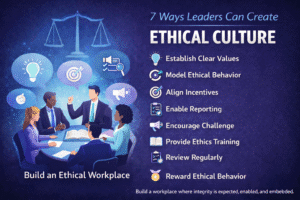
Here are seven practical and strategic ways leaders can create and sustain an ethical culture.
1. Establish Clear and Lived Values
Every ethical culture begins with clarity. Leaders must define organisational values clearly – but more importantly, ensure those values are operationalised.
Ask:
- Are our values specific or generic?
- Do they guide real decisions?
- Can employees explain what they mean in practice?
For example, if “integrity” is a value, what does it look like in procurement decisions? In performance reviews? In financial reporting? In customer communication?
Ethical culture is strengthened when values are translated into behavioural expectations.
Leaders should regularly communicate how values inform strategy, decision-making, and trade-offs. When employees see values guiding real choices – especially difficult ones – credibility increases.
Without clarity and consistency, values become branding, not governance.
2. Model Ethical Behaviour at the Top
Tone from the top is not symbolic – it is structural.
Employees observe leadership behaviour closely. They watch:
- How leaders handle mistakes
- How they respond to bad news
- Whether they accept accountability
- Whether they speak respectfully under pressure
- Whether they prioritise long-term trust over short-term results
Ethical culture cannot survive leadership hypocrisy.
If senior leaders cut corners, dismiss concerns, or rationalise questionable decisions, ethical standards collapse quickly.
Creating ethical culture requires leaders to demonstrate:
- Transparency
- Humility
- Accountability
- Courage in difficult decisions
People follow behaviour, not mission statements.
3. Align Incentives with Integrity
One of the most overlooked drivers of ethical culture is incentives.
Compensation structures, performance metrics, and promotion criteria shape behaviour more powerfully than policy documents.
Leaders must examine:
- What behaviour is rewarded?
- What behaviour is ignored?
- What behaviour is quietly tolerated?
If bonuses are tied solely to financial performance, short-termism may increase.
If managers are penalised for raising risk, issues will be hidden.
If high performers are promoted despite toxic conduct, culture deteriorates.
Ethical leadership requires aligning performance systems with ethical standards.
Reward not only outcomes — reward how outcomes are achieved.
This alignment reduces ethical drift and reinforces that integrity is not optional.
4. Create Psychological Safety and Safe Reporting Channels
An ethical culture depends on voice. Employees must feel safe to:
- Raise concerns
- Challenge decisions
- Report misconduct
- Admit mistakes
Without psychological safety, risk becomes invisible. Leaders can strengthen ethical culture by:
- Encouraging respectful dissent
- Protecting whistleblowers
- Responding constructively to criticism
- Acting promptly on reported concerns
- Avoiding retaliation – formally and informally
A culture where employees fear consequences for speaking up is a culture where ethical failures grow quietly.
Psychological safety is not about comfort – it is about protection from punishment for honesty.
5. Provide Practical Ethics Training and Decision Frameworks
Ethical culture is strengthened when people are equipped to make sound decisions under pressure.
Training should go beyond policy awareness.
It should include:
- Realistic scenarios
- Ethical dilemma discussions
- Bias awareness
- Decision-making frameworks
- Escalation guidance
Leaders should encourage teams to ask:
- Who could be harmed by this decision?
- Is this aligned with our values?
- Would we defend this publicly?
- What are the long-term consequences?
Embedding ethical thinking into everyday decisions transforms culture from reactive to proactive.
When ethical judgement becomes part of strategic discussion, governance maturity increases.
6. Review Culture and Ethics Regularly
Ethical culture is dynamic. External pressures, growth, restructuring, leadership changes, and market shifts can all impact ethical standards.
Leaders should treat culture oversight as seriously as financial oversight.
This includes:
- Conducting regular ethical culture assessments
- Reviewing whistleblower trends
- Analysing misconduct data
- Evaluating leadership behaviour patterns
- Seeking independent governance reviews
Boards should ask:
- Are there early warning signs of ethical drift?
- Do employees trust reporting mechanisms?
- Is there consistency in policy enforcement?
Ethical governance requires ongoing vigilance.
Complacency is one of the greatest risks to ethical culture.
7. Reward Ethical Behaviour Publicly and Consistently
Culture is reinforced through recognition. If leaders want to create ethical culture, they must visibly reward ethical behaviour – especially when it involves courage.
Recognise individuals who:
- Raise concerns early
- Admit errors transparently
- Prioritise integrity over convenience
- Protect stakeholder interests
- Demonstrate ethical judgement under pressure
Public reinforcement signals that ethical behaviour is valued.
When ethical decisions are celebrated – not just tolerated – integrity becomes aspirational rather than burdensome.
Rewarding ethical behaviour transforms ethics from compliance obligation to cultural strength.
Why Ethical Culture Matters for Long-Term Success
Creating ethical culture is not only a moral responsibility – it is a strategic advantage.
Organisations with strong ethical culture experience:
- Higher employee engagement
- Stronger stakeholder trust
- Reduced regulatory risk
- Lower turnover
- Greater reputational resilience
- More sustainable growth
In contrast, weak ethical cultures often lead to:
- Reputational damage
- Litigation and compliance failures
- Leadership instability
- Financial loss
- Loss of public trust
Ethical culture is a risk management strategy, a leadership discipline, and a competitive differentiator.
Final Reflection
Creating ethical culture is not about perfection. It is about consistency.
It is about aligning:
- Values
- Leadership behaviour
- Incentives
- Accountability systems
- Reporting mechanisms
- Recognition frameworks
When these elements work together, ethical culture becomes embedded – not imposed.
Leadership defines culture.
Every decision sends a signal.
Every reaction reinforces a norm.
Every reward shapes behaviour.
The question is not whether your organisation has a culture. It does.
The question is:
Is it intentionally ethical — or accidentally risky?
If you are committed to building a culture where integrity is expected, enabled, and rewarded, leadership must move beyond intention to design.
Because ethical culture does not happen by chance.
It is built – deliberately – by leaders who understand that governance and integrity are inseparable.
If you’re ready to move beyond statements of intent and intentionally design a culture of integrity, Ethical Governance can partner with your board and executive team to align values, incentives, and accountability systems – so ethical behaviour becomes embedded, measurable, and sustainable.
Sanela Osmic GAICD is the Founder of Ethical Governance and the developer of the Osmic Governance Architecture™ and the Governance Architecture Diagnostic™. The GAD is available for individual director assessments and full board engagements. Contact us for more details.
Comments