
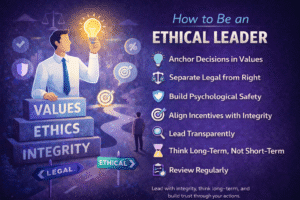
As a leader, you have the power to influence the behaviour and actions of those around you. This means that you have a responsibility to lead with ethics and integrity.
Ethical leadership is often misunderstood.
It is not about being nice.
It is not about avoiding conflict.
It is not about quoting values on a website.
Ethical leadership is about alignment – between what you say, what you decide, what you tolerate, and what you reward.
It is most visible not when everything is calm, but when pressure rises.
Because ethics is easy in comfort.
It is tested in tension.
In boardrooms, executive teams, public office, and growing organisations, ethical leadership is not a “soft skill.” It is a strategic capability. It determines trust, culture, reputation, and long-term sustainability.
So what does it actually take to be an ethical leader?
Below are seven practical disciplines that separate ethical intent from ethical leadership.
1. Anchor Decisions to Values – Especially When It Costs You
Every organisation claims to have values. Few leaders are willing to lose revenue, status, or speed in order to uphold them.
Ethical leadership begins when you choose principle over convenience.
That might look like:
- Turning down a profitable contract that compromises your standards.
- Disclosing uncomfortable information rather than protecting optics.
- Delaying a strategic initiative because stakeholder impact hasn’t been fully considered.
- Refusing to manipulate data to create a better narrative.
Ethical leadership is not about having values when they are free. It is about acting on them when they are expensive.
If your values have never cost you anything, they are probably not leading your decisions.
2. Separate “Legal” From “Right”
One of the most common ethical traps in leadership is equating legality with morality.
“It’s compliant” is not the same as “it’s ethical.”
Legal frameworks establish minimum standards. Ethical leadership asks:
- Is this fair?
- Is this transparent?
- Is this respectful of human dignity?
- Would I defend this publicly without qualification?
Some of the most damaging organisational failures were legal – until they weren’t.
An ethical leader understands that reputation, legitimacy, and trust operate above the legal line.
If your primary defence of a decision is “it’s allowed,” that is a warning signal.
3. Build Psychological Safety for Dissent
You cannot be an ethical leader if no one can challenge you. Ethical failures often occur not because leaders lack awareness – but because the environment suppresses challenge.
People stay silent when:
- They fear retaliation.
- They feel ignored.
- They see others punished for speaking up.
- They believe the decision has already been made.
An ethical leader actively creates space for discomfort. That includes:
- Asking, “What are we missing?”
- Inviting disagreement in meetings.
- Rewarding those who raise concerns early.
- Protecting whistleblowers – even when it is inconvenient.
- Reflecting openly when you were wrong.
Ethical leadership is not about always being right.
It is about ensuring the truth can reach you.
4. Align Incentives With Integrity
Culture is not shaped by speeches. It is shaped by what gets rewarded.
If you promote high performers who deliver results through intimidation, your culture will mirror that behaviour.
If bonuses are tied only to financial metrics, short-termism will rise.
If managers are penalised for escalating risk, risk will be hidden.
An ethical leader examines systems, not just individuals.
Ask yourself:
- What behaviour do we celebrate?
- What behaviour do we tolerate?
- What behaviour quietly succeeds here?
Integrity cannot survive misaligned incentives.
Ethical leadership requires structural alignment between performance frameworks and moral standards.
5. Practice Self-Awareness Under Pressure
Most ethical failures are emotional before they are strategic.
They emerge from:
- Ego
- Fear
- Pride
- Urgency
- Insecurity
- The need to win
An ethical leader develops emotional intelligence – not as a trend, but as a discipline.
This includes recognising when:
- You are rationalising.
- You are defensive.
- You are protecting image over truth.
- You are reacting rather than responding.
- You are justifying behaviour you would criticise in others.
The most dangerous moment in leadership is when you are certain you are right – and unwilling to question yourself.
Ethical leadership requires humility.
It requires the capacity to pause and ask:
“Am I choosing what is right – or what protects me?”
As a leader, your actions speak louder than words. If you want your team to act with integrity, you need to model that behaviour yourself. This means being honest, transparent and consistent in your actions and decisions. Show your team that you value ethical behaviour by prioritizing it in your own work and interactions.
6. Lead Transparently – Especially When Mistakes Happen
Ethical leaders do not hide behind silence. They communicate openly – not recklessly, but responsibly.
Transparency includes:
- Acknowledging errors.
- Sharing reasoning behind decisions.
- Clarifying trade-offs.
- Explaining constraints honestly.
- Avoiding manipulative messaging.
Stakeholders do not expect perfection. They expect integrity.
When leaders hide information to protect reputation, they often damage reputation more deeply.
Trust is not built by flawless performance. It is built by honest stewardship.
7. Think Long-Term, Not Just Short-Term
Ethical leadership is inherently long-term. Short-term decisions often tempt leaders to:
- Overpromise.
- Underspend on safety.
- Delay risk mitigation.
- Compromise stakeholder interests.
- Prioritise quarterly outcomes over sustainable impact.
But ethical leadership considers consequences beyond immediate metrics.
It asks:
- What precedent does this set?
- What culture does this reinforce?
- How will this decision affect future trust?
- Are we building resilience – or fragility?
The ethical leader recognises that reputational capital is built slowly and lost quickly.
Sustainable success is rooted in moral credibility.
Warning Signs You May Be Drifting
Ethical leadership requires vigilance. Here are subtle signals of drift:
- You justify decisions more often than you question them.
- You dismiss critics rather than listening to them.
- You rely heavily on legal advice to validate uncomfortable choices.
- You feel defensive when challenged.
- You notice silence in rooms where there should be debate.
- You believe ethical failures “couldn’t happen here.”
Ethical drift is rarely dramatic at the beginning.
It is gradual.
It happens when small compromises accumulate.
Ethical leaders are not immune to error. They are alert to it.
Ethical Leadership in Governance Contexts
For board directors and senior executives, ethical leadership carries an additional dimension: stewardship.
You are not only responsible for decisions.
You are responsible for tone, oversight, and institutional legitimacy.
This means:
- Ensuring policies align with values.
- Holding executives accountable consistently.
- Reviewing culture as seriously as financial performance.
- Asking difficult questions about risk exposure.
- Considering stakeholder impact beyond shareholder return.
Ethical governance requires courage at the top.
Without it, compliance becomes performance theatre.
Final Reflection
Being an ethical leader is not about perfection.
It is about discipline.
It is about consistency between belief and behaviour.
It is about protecting trust – especially when pressure invites compromise.
In today’s environment, stakeholders are more informed, expectations are higher, and reputational risk travels faster than ever.
Ethical leadership is no longer optional.
It is strategic.
Because intelligence without integrity creates fragility.
Power without ethics creates risk.
Success without values creates instability.
But leadership grounded in ethics creates something far more durable:
Credibility.
And credibility is the foundation of sustainable influence.
The real question is not:
“Do I see myself as ethical?”
It is:
“Would those impacted by my decisions agree?”
That is where ethical leadership truly begins.
If you want to move beyond policy and build leaders who can think, decide, and act ethically under pressure, Ethical Governance partners with boards and executives to embed integrity into strategy, culture, and decision-making – because ethical leadership doesn’t happen by chance, it is designed.
Sanela Osmic GAICD is the Founder of Ethical Governance and the developer of the Osmic Governance Architecture™ and the Governance Architecture Diagnostic™. The GAD™ is available for individual director assessments and full board engagements. Contact us for more details.
Comments