
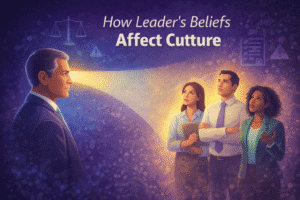
“Believing the best in people usually brings the best OUT of people.”
John C. Maxwell
Culture is not built by strategy decks.
It is built by belief.
And one of the most underestimated forces in leadership is this:
What you believe about people determines who they become in your organisation.
Every leader holds a silent assumption about their team.
Do you believe people are capable – or limited?
Do you believe they are trustworthy – or need constant control?
Do you believe they are creative – or only compliant?
Do you believe they can grow – or that talent is fixed?
Your answers shape culture more than any policy ever will.
Because people rise – or shrink – to the level of belief placed upon them.
If I would ask you to name one person that had a significant impact on you, I am sure you will instinctively think of someone who believed in you at a crucial point in your life. He or she reached out to you just as you were about to give up on your goal.
Most of us would do the same because as humans we continuously strive for success and need an environment conducive of growth.
So do your employees. People stopped working just for money long time ago. They work for a purpose nowadays and want (intellectual) challenge, to make a difference and look beyond the short-term sales.
And somewhere in your organisation right now, you may have a genius who is operating at 40% capacity – simply because no one truly believes in them

To build a truly healthy organisational culture, leaders must consciously recognise and develop talent – not just recycle familiarity.
Too often, promotions are influenced by unconscious bias rather than capability. We tell ourselves someone is “not quite ready” or “not the right fit,” without interrogating what that really means. As a result, young professionals struggle to advance, diverse voices remain underrepresented, and boardrooms and C-suites continue to reflect the same narrow profiles.
When decisions are driven by comfort instead of courage, the status quo prevails. The outcome is predictable: the perpetuation of the “male, pale and stale” model of leadership – not because talent is lacking, but because belief and opportunity are unevenly distributed.
Healthy cultures do not default to familiarity.
They intentionally widen the lens of who is seen, trusted, and elevated.
Leadership Is a Mirror
Employees do not just respond to instructions. They respond to expectations.
When a leader subtly communicates:
- “I don’t trust you.”
- “Just follow the process.”
- “Don’t think too much.”
- “Stay in your lane.”
Innovation dies quietly.
Confidence contracts.
Risk-taking disappears.
But when a leader communicates – verbally and behaviourally:
- “I trust your judgement.”
- “I value your thinking.”
- “I want to hear your perspective.”
- “You are capable of more.”
Something shifts.
Belief unlocks potential.
This is not motivational theory. It is behavioural reality.
People internalise how they are seen.
The Ethical Dimension of Belief
Believing in people is not just inspirational – it is ethical.
When leaders assume incompetence, they create cultures of control.
When leaders assume capability, they create cultures of empowerment.
Control cultures produce compliance.
Empowered cultures produce ownership.
Ownership changes everything.
An employee who feels trusted will:
- Speak up earlier.
- Raise risks proactively.
- Take initiative.
- Defend integrity.
- Go beyond minimum expectations.
An employee who feels distrusted will:
- Stay silent.
- Avoid responsibility.
- Protect themselves first.
- Do only what is required.
The difference begins in belief.
You Might Have a Genius Sitting Quietly
In many organisations, the loudest voices dominate. Confidence is mistaken for competence. Visibility is mistaken for value.
Meanwhile, thoughtful, reflective, high-potential individuals operate below the radar.
Why?
Because their ideas were dismissed once – and they stopped offering them.
Because they were micromanaged into smallness.
Because leaders consciously and unconsciously favour familiarity over difference.
The tragedy is not that talent doesn’t exist. It is that talent is never activated.
A leader who believes in potential sees beyond current performance.
They ask:
- What could this person become with the right support?
- What assumptions am I making about their capability?
- Have I given them room to lead?
Belief precedes development.
Culture Expands or Contracts Around Leadership Belief
If you believe people cannot be trusted, you will design layers of approval.
If you believe people lack judgement, you will centralise decision-making.
If you believe only a few are capable, you will concentrate power.
And culture will reflect those assumptions.
But if you believe intelligence is distributed, not concentrated…
If you believe creativity can emerge anywhere…
If you believe growth is possible…
Then you design differently.
You delegate meaningfully.
You invite ideas.
You share responsibility.
You tolerate learning curves.
And suddenly culture becomes expansive.
Belief Creates Psychological Safety
One of the most powerful outcomes of leader belief is psychological safety.
When leaders believe in their people, they allow space for:
- Imperfect drafts
- Early-stage ideas
- Constructive disagreement
- Questions without ridicule
- Learning through experimentation
Genius rarely appears fully formed. It emerges through iteration. But iteration requires safety.
When leaders react harshly to mistakes, they communicate:
“Do not risk.”
When leaders respond with curiosity, they communicate:
“Grow.”
Belief is the foundation of safety. Safety is the foundation of innovation.
The Governance Perspective
From a governance standpoint, believing in people strengthens ethical culture.
Why?
Because ethical culture depends on voice.
If leaders believe:
- “Only I can make good decisions”
- “Risk functions are obstacles”
- “Frontline staff don’t understand strategy”
They unintentionally silence insight.
Yet some of the most critical early warnings in organisations come from people closest to the work.
Believing in others increases:
- Early risk identification
- Accountability ownership
- Integrity reinforcement
- Diverse perspective integration
Belief is not blind optimism without discernment. It is strategic trust.
The Self-Fulfilling Leadership Cycle
There is a well-documented phenomenon in leadership psychology: expectations influence outcomes.
If you expect mediocrity, you get compliance.
If you expect excellence, you get effort.
If you expect integrity, you get responsibility.
If you expect ownership, you get initiative.
The leader who believes “my team will rise” behaves differently.
They invest differently.
They challenge differently.
They listen differently.
And those behaviours create the very outcomes they anticipated.
Belief becomes culture.
Practical Ways to Activate Belief
Believing in others is not abstract. It is visible. Here are practical shifts:
1. Ask Better Questions
Instead of giving answers immediately, ask:
“What do you think we should do?”
2. Delegate Stretch Opportunities
Growth requires discomfort. Assign responsibility before someone feels fully ready.
3. Publicly Acknowledge Insight
Recognise thoughtful contributions – especially from quieter voices.
4. Avoid Micromanagement
Control communicates distrust. Clarity plus autonomy communicates confidence.
5. Separate Mistakes from Identity
Correct behaviour without diminishing capability. These micro-signals accumulate. And culture shifts.
The Leader’s Responsibility
The power of believing in others is not sentimental. It is transformative. Some of the most capable people in your organisation may not yet believe in themselves. They are waiting for someone to see them.
Leadership is not only about vision. It is about recognition.
It is about seeing what others might become – and creating conditions where that future is possible.
You might already have extraordinary talent.
The question is not whether genius exists.
The question is whether your belief is strong enough to unlock it.
One of the clearest signals of your corporate culture isn’t what’s written in your values statement – it’s your employee turnover rate. When talented people consistently choose to leave, it’s rarely just about salary; it’s often a reflection of trust, leadership, and how people experience the culture. A persistently high turnover rate is not a coincidence – it’s a cultural indicator that warrants serious reflection and deliberate change.
“Keep away from people who try to belittle your ambitions.
Small people always do that,
but the really great make you feel that you, too, can become great.”
Mark Twain
If you want to build a culture where potential is activated, ownership is encouraged, and integrity is strengthened through trust, Ethical Governance works with boards and executive teams to align leadership mindset with sustainable cultural impact.
Because culture doesn’t begin with policy.
It begins with belief.
Sanela Osmic GAICD is the Founder of Ethical Governance and the developer of the Osmic Governance Architecture™ and the Governance Architecture Diagnostic™. The GAD™ is available for individual director assessments and full board engagements. Contact us for more details.
Comments