
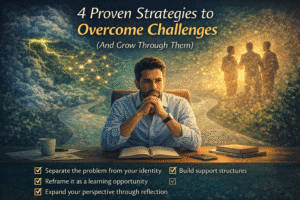
So many people wish life was easier, with less challenges and obstacles but without challenges, life becomes stagnant and we stop growing.
Challenges are inevitable.
No leader, organisation, or high-performing individual escapes them. What does distinguish those who overcome from those who stagnate is not talent, luck, or resources.
It’s how they engage with the challenge itself.
“It is lack of faith that makes people afraid of meeting challenges, and I believed in myself.”
Muhammad Ali
Challenges are not obstacles blocking your path – they are tests of capacity, character, and clarity.
The way you respond to difficulty shapes not only the outcome, but the leader you become.
Below are four strategies that don’t just help you navigate challenges – they help you grow through them, strengthen emotional intelligence, and lead with integrity.
1. Separate the Problem from Your Identity
When a challenge arises, the first trap many fall into is internalising it. We think:
- “This means I’m not good enough.”
- “I’m failing.”
- “I should have handled this better.”
This internal response turns the challenge into a statement about who you are, rather than what you’re facing.
But here’s the difference:
A challenge is an event. Your identity is your essence. They are not the same.
Strong leaders make this distinction explicitly:
- The challenge exists outside of who you are.
- Your capability is demonstrated in how you approach it.
- Your identity remains grounded in effort, not outcome.
This mindset shift is not semantics – it is foundational.
When you separate the issue from self-worth, you:
- Reduce emotional paralysis
- Increase clarity of thought
- Expand your capacity to act from strength, not fear
Emotional intelligence grows when you manage your internal narrative, not just your external responses.
2. Reframe the Challenge as a Learning Opportunity
Challenges are rarely linear. If you think the path forward is:
Problem → Solution → Victory
…you’re approaching complexity with an oversimplified model.
Most challenges involve:
- Uncertainty
- Conflicting signals
- Unexpected consequences
- Missing information
- Emotional pressures
When you reframe a challenge as a learning event, you unlock a higher order of engagement.
Instead of asking:
- “How do I get out of this?”
- “What should I avoid?”
Ask:
- “What is this teaching me?”
- “How can this expand my capacity?”
- “What insight will this give me that future decisions won’t?”
This reframing doesn’t minimise difficulty. It elevates mindset. It moves you from survival mode into growth mode.
And growth is where resilience, confidence, and strategic clarity emerge.
3. Expand Your Perspective Through Strategic Reflection
In the midst of difficulty, the tendency is to narrow focus. You fixate on the immediate problem.
But a narrow focus under stress almost always leads to:
- Tunnel vision
- Missed signals
- Reactive decision-making
- Emotional overload
This is where reflection becomes a strategic tool – not a luxury. Reflection allows you to:
- Position the challenge in broader context
- Identify assumptions limiting your choices
- Recognise patterns rather than react to events
- Separate emotion from rational analysis
Here are powerful reflective questions leaders use:
- What assumptions am I making right now?
- What do I not know that matters?
- What alternative perspectives am I ignoring?
- How would I advise a peer in this situation?
- If this were someone else’s challenge, how would I evaluate it?
Reflection enables you to step back from the immediacy of stress and see the structure of the challenge.
This is not introspection for its own sake. This is decision-quality enhancement.
4. Build Support Structures — Because You Don’t Overcome Alone
One of the most persistent myths about leadership is this:
“Great leaders solve challenges independently.”
This is false. Solitary problem-solving under pressure is a recipe for:
- Blind spots
- Biased assumptions
- Emotional overload
- Misinterpretation of signals
Effective leaders build support structures – systems that expand perspective and fortify resolve. Support structures may include:
- Trusted advisors: Voices who can question assumptions without ego.
- Mentors and coaches: People who have faced similar challenges with discernment and wisdom.
- Peer leadership circles: Communities where experience is shared and learning is accelerated.
- Emotional intelligence coaching: Focused development to regulate emotional reactivity and strengthen judgement.
- Well-defined governance frameworks: Systems that ensure decisions are tested, not just made.
Leaders who rely solely on their own reasoning are limited by the bounds of their own experience.
But leaders who draw on community, counsel, and structured thinking expand their capacity exponentially.
Why These Strategies Work
These four strategies are not reactive tactics. They are strategic disciplines that elevate thinking, strengthen resilience, and reinforce integrity.
They work because they:
✔ Shift identity away from outcome
✔ Transform adversity into growth
✔ Expand decision quality through reflection
✔ Distribute cognitive load through community
They enhance not only what you do – but how you think.
And in leadership, how you think determines how you lead.
The Role of Emotional Intelligence
What underpins all of these strategies is emotional intelligence (EI). EI is not soft. It is not optional. It is a leadership capability that directly influences decision-making, stress response, and relational influence.
Strong emotional intelligence enables you to:
- Separate ego from problem
- Recognise emotional triggers before they hijack judgement
- Communicate clearly under pressure
- Navigate conflict without compromising integrity
- Influence others without coercion
- Stay anchored to values when stakes are high
The leader who has developed EI does not ignore emotion. They master it.
And that mastery elevates every challenge from threat to opportunity.
Final Reflection
If you are facing a challenge right now – whether strategic, relational, operational, or personal – remember this:
Challenges are not interruptions to your leadership journey.
They are part of it.
How you engage with them will determine not just the outcome – but the leader you become through the encounter.
Strength does not emerge from comfort.
Strength emerges from disciplined engagement with difficulty.
Your success is not defined by how easily you avoid problems,
but by how deliberately you face them.
“Bad times have a scientific value. These are occasions a good learner would not miss.”
Ralph Waldo Emerson
If you want to strengthen your capacity to navigate challenges with clarity, resilience, and integrity, Emotional Intelligence Coaching with Ethical Governance can help you build the self-aware mindset and strategic discipline that turns conflict into growth.
Comments