
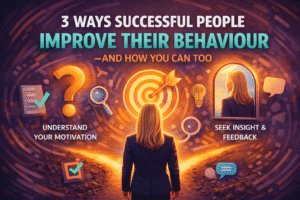
Improving behaviour isn’t simply about wanting to be better – it is about understanding why behaviour matters, what drives it, and how real, lasting change actually happens.
At its heart, behaviour is the visible expression of our thoughts, motivations, beliefs and habits. If we want different results in our work, relationships, leadership influence or personal wellbeing, we must look at the drivers of behaviour and intentionally shape them.
This isn’t easy – but the most successful people don’t rely on chance. They engage in deliberate, thoughtful work on themselves. Here are three fundamental ways they do it.
1. They Understand the Motivation Behind Behaviour
Most behaviour stems from motivation – the why behind what we do. Motivation isn’t a simple force; it is complex and dynamic. People are driven either by approach motivation (the desire to gain rewards) or avoidance motivation (the desire to avoid discomfort or harm). Understanding which motivation drives a specific behaviour helps decode why it exists and how to shift it.
Successful people explore this root – not just the surface behaviour. Instead of asking “What am I doing?” they dig deeper and ask, “Why am I doing it?” and “What need is this behaviour actually fulfilling?”
For example, someone who procrastinates might think the problem is poor time management. But the underlying motivation might be fear of failure or fear of judgment. The behaviour is just the symptom.
This shift – from consequence to cause – is crucial for meaningful behavioural change.
“Human behaviour flows from three main sources: desire, emotion, and knowledge.”
Plato
2. They Practise Consistently and Build New Habits
Once motivation is understood, the next step is practice – and not just occasional effort, but consistent, structured practice.
The brain loves familiarity and routine. It embeds repetitive actions into neural pathways so that behaviours become automatic over time. That’s how habits form.
Successful people don’t just hope behaviour will improve – they design systems that make good behaviour easier and automatic:
Start small and specific. Instead of vague goals like “be more productive,” they define specific, achievable actions – for example:
- “I will write the first draft of my report by 9am every Monday”
- “I will practice active listening in every meeting this week”
This approach is called an implementation intention – a specific if-then plan that links a situation to a desired action (e.g., If it’s Monday at 9am, then I start writing). These plans significantly increase the likelihood of behaviour change because they remove ambiguity and create automatic responses.
Repetition matters. It’s one thing to make a decision, but forming a new behaviour into a habit typically takes time – often months of regular practice – before it becomes second nature.
Successful people track this progress. They don’t rely on willpower alone. They measure, reflect, and adjust – because purposeful practice yields results.
3. They Seek Feedback and Shape Their Behaviour Through Reflection
One of the biggest differences between people who want to improve and those who do improve is feedback.
Feedback – when done thoughtfully – helps us see blind spots. It highlights patterns we can’t see on our own, challenges our assumptions, and exposes the gaps between intention and impact.
Effective learners – including the most successful people – actively seek feedback from trusted peers, mentors, coaches or advisers. They don’t wait to be told what to improve; they ask:
- “Where could I have acted differently?”
- “What behaviour of mine made the biggest impact – positive or negative?”
- “What is the one thing I could do better next time?”
They use this information as material for reflection – a moment to pause, think critically, and set clear intentions for improvement.
Moreover, by engaging others in honest conversation, they strengthen their self-awareness – the foundation of emotional intelligence and personal effectiveness.
Why These Strategies Work
Improving behaviour isn’t about forcing yourself to act differently for a day or a week. It’s about changing the underlying mechanisms that shape behaviour:
- Understanding motivation gives context. It answers why you do what you do.
- Habit formation through consistent practice makes desirable behaviours automatic over time.
- Feedback and reflection create learning loops, helping you refine and adapt behaviour based on real outcomes.
Taken together, these strategies transform behaviour from something that happens to you into something you intentionally shape.
Beyond Patterns – Towards Purposeful Change
At its core, behaviour change is about alignment – aligning who you are with who you want to be.
Successful individuals recognise that behaviour influences outcomes in profound ways. They know that if they want better relationships, stronger leadership, higher performance or greater wellbeing, they must be willing to engage with themselves honestly and intentionally.
Successful behaviour change isn’t about perfection – it’s about commitment: commitment to clarity, commitment to consistency, and commitment to reflection.
This is why behaviour change is not a one-off goal, but a lifetime practice.
“The greatest discovery of my generation is
that human beings can alter their lives by altering their attitudes of mind.”
William James
Conclusion: The Journey of Becoming
To change behaviour, you must:
- Understand your deeper motivations
- Build new patterns through deliberate practice
- Seek insight and feedback that lead to continuous refinement
The pathway isn’t always simple, but it is clarity – not chaos – that creates progress.
“The self-image is the key to human personality and human behaviour.
Change the self-image and you change the personality and the behaviour.”
Maxwell Maltz
Behaviour does not change because you understand it.
It changes when you are willing to work on it – consistently and strategically.
If you’re ready to move beyond insight and into real transformation, coaching creates the structure, accountability and clarity you need. Together, we identify the patterns driving your results, challenge limiting beliefs, and design practical behavioural shifts that align with your goals and values.
You don’t need more information.
You need intentional action.
Sanela Osmic GAICD is the Founder of Ethical Governance and the developer of the Osmic Governance Architecture™ and the Governance Architecture Diagnostic™. The GAD™ is available for individual director assessments and full board engagements. Contact us for more details.
Comments