

A Behavioural Governance Framework for Boards, Chairs and Executive Leaders
Most governance failures are not policy failures.
They are behavioural failures.
Boards with comprehensive frameworks, documented procedures and sophisticated compliance systems still produce decisions that damage organizations, erode trust and expose leaders to personal and institutional risk.
The reason is consistently the same.
Governance fails when the human drivers of decision-making — character, judgement and structure — become misaligned under pressure.
The Osmic Governance Architecture™ is a proprietary behavioural governance framework developed by Sanela Osmic to address precisely this. It explains how leadership character, strategic judgement and governance architecture interact — within environments shaped by culture, incentives and external pressure — to determine whether organizational decisions hold their integrity when it matters most.
This is not a compliance framework. It is a governance architecture built for boards that want to understand — and strengthen — how governance actually behaves in practice.
What Is Behavioural Governance?
Behavioural governance is a discipline that examines how human behaviour — not policy documentation — determines governance outcomes.
Traditional governance asks: do we have the right structures in place?
Behavioural governance asks: are the people within those structures making decisions with integrity, under pressure, when no one is watching?
It recognises that every governance system is ultimately operated by human beings — leaders whose character, cognitive patterns and decision-making quality are shaped by the culture and incentives surrounding them. When those human factors are strong and aligned, governance holds. When they are not, governance fails — regardless of how robust the documentation appears.
The Osmic Governance Architecture™ is the foundational framework of behavioural governance. It provides boards with a structured, evidence-informed model for diagnosing and strengthening the human dimensions of governance that traditional frameworks overlook.
The Osmic Governance Architecture™
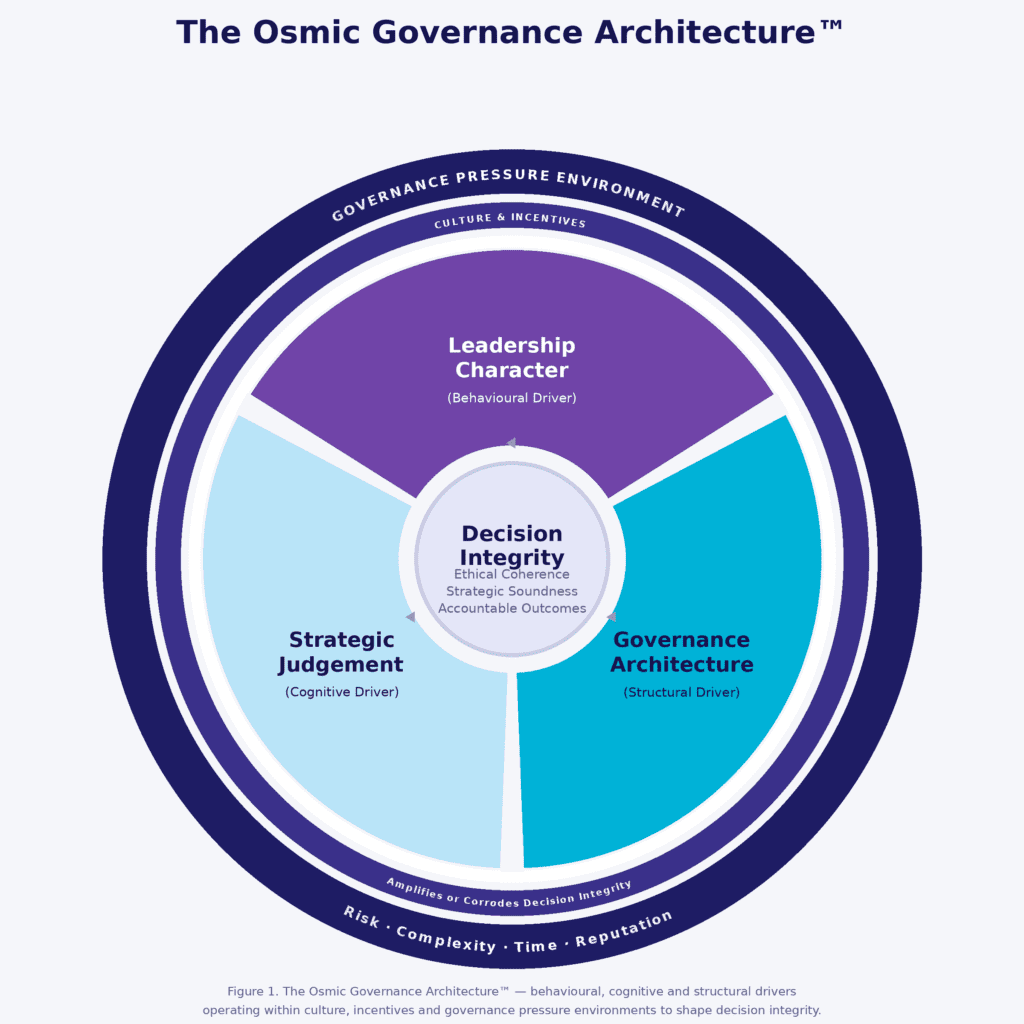
The model identifies three active drivers of governance integrity — behavioural, structural and cognitive — operating within two environmental layers that amplify or constrain their effectiveness.
When all three drivers are aligned, and the environment reinforces rather than corrodes them, the result is Decision Integrity: decisions that are defensible, ethically coherent, purpose-aligned and resilient under scrutiny.
When any driver weakens — or when the environment actively works against them — the governance system destabilizes, even when policies appear sound.
The Three Drivers of Governance Integrity
1. Leadership Character — The Behavioural Driver
Governance depends, fundamentally, on how power is exercised.
Leadership character is the behavioural driver — the dimension of governance that determines whether accountability is embraced or quietly deflected when pressure increases. Structures cannot compensate for weak character. Policies cannot substitute for the courage to act on them.
Character under pressure reveals what governance is actually built on. The four qualities that define this driver are:
- Integrity: Consistent alignment between stated values and actual decisions — especially when no one is watching.
- Courage: The willingness to challenge, escalate and dissent when it is uncomfortable to do so.
- Accountability: Taking genuine ownership of decisions and their consequences, rather than distributing blame or deflecting scrutiny.
- Emotional Intelligence: The capacity to recognise emotional dynamics — in oneself and others — and exercise governance with self-awareness and interpersonal discipline.
Governance discipline begins with leadership behaviour.
2. Governance Architecture — The Structural Driver
Governance architecture refers to the deliberate design of oversight, authority and accountability within an organization — the structural environment in which decisions are made and supervised.
Architecture determines how governance actually operates in practice, not merely how it is documented. It shapes whether power flows with clarity, whether risk is genuinely integrated into decision-making, and whether escalation pathways function when they are most needed.
The four structural elements that define this driver are:
- Board Oversight: The design and discipline of how boards monitor executive decisions, challenge assumptions and maintain independent judgement.
- Authority & Role Clarity: Explicit, understood boundaries around who decides what — reducing ambiguity, diffusion of responsibility and governance gaps.
- Information Flow: The quality, completeness and timeliness of information reaching decision-makers — without distortion, omission or framing that skews judgement.
- Escalation Pathways: The structural mechanisms through which concerns, risks and dissenting views can surface safely and reach the right level of authority before they become crises.
Architecture determines what governance makes possible. Character determines what governance actually does.
3. Strategic Judgement — The Cognitive Driver
The quality of governance is ultimately measured by the quality of decisions made within it.
Strategic judgement is the cognitive driver — the dimension of governance that determines how leaders reason under uncertainty, navigate competing interests and evaluate the long-term consequences of their choices. Information availability is necessary but never sufficient. Governance effectiveness depends on the quality of judgement applied to it.
The four cognitive capacities that define this driver are:
- Bias Awareness: Recognizing how cognitive biases — groupthink, confirmation bias, authority deference — silently distort decision-making in board environments.
- Risk Framing: The capacity to define, interrogate and stress-test risk in ways that reflect genuine uncertainty rather than institutional comfort.
- Stakeholder Impact: Evaluating decisions through the lens of those affected — shareholders, employees, communities — before commitment rather than after consequences.
- Ethical Reasoning: Applying disciplined ethical analysis to high-stakes decisions, especially under time pressure and reputational exposure.
Judgement is not instinct. It is a disciplined skill — and it can be developed.
The Two Environments That Shape Every Decision
The three drivers do not operate in isolation. They function within two distinct environmental layers — one internal, one external — that either reinforce or actively corrode governance integrity.
Culture & Incentives — The Internal Environment
Beneath every decision lies the incentive environment.
What gets rewarded. What gets tolerated. What gets ignored. What gets quietly encouraged regardless of what the values statement says.
Culture and incentives are the internal climate of governance. They shape whether leaders feel safe to challenge, whether escalation pathways are actually used, whether accountability is real or performative. A board can design strong architecture and recruit leaders of genuine character — and still watch governance fail if the surrounding culture corrodes both.
No governance system can outperform the incentives that surround it.
The Osmic Governance Architecture™ therefore treats culture and incentives not as a soft people matter but as a structural governance risk — one that must be assessed, designed and actively maintained.
Governance Pressure Environment — The External Environment
Boards rarely make decisions in neutral conditions.
They operate under time pressure, reputational exposure, regulatory scrutiny, stakeholder activism and strategic uncertainty — often simultaneously. These external pressures are not exceptional events. They are the normal operating environment of modern governance.
The significance of the pressure environment is not that it creates governance risk — it is that it reveals governance reality. Pressure exposes whether character holds, whether structures function and whether judgement is disciplined or reactive.
The Osmic Governance Architecture™ examines governance not in theory, but under pressure — when it matters most.
Decision Integrity – The Outcome
Decision integrity is what results when character, architecture and judgement are aligned — and when the surrounding environment reinforces rather than undermines them.
A decision has integrity when it is:
- Defensible — capable of withstanding regulatory, stakeholder and media scrutiny
- Ethically coherent — consistent with the organization’s stated values and purpose
- Purpose-aligned — serving long-term institutional interests, not short-term pressure
- Resilient under review — able to be examined retrospectively without distortion or justification
Decision integrity is not a permanent state. It is maintained — or lost — decision by decision, under the conditions that governance systems are actually subjected to.
When one driver weakens, the consequences are predictable:
- Character weak → power distortion — decisions serve individual interests rather than institutional ones
- Judgement weak → rationalized harm — flawed reasoning produces defensible-sounding decisions with damaging outcomes
- Architecture weak → structural chaos — accountability diffuses, escalation fails, oversight loses grip
The governance system destabilizes — even when the policy documentation appears sound.
Behavioural Governance vs Traditional Governance Frameworks
Traditional governance frameworks — including many national corporate governance codes and regulatory compliance models — centre primarily on structural adequacy. They ask whether the right mechanisms exist.
The Osmic Governance Architecture™ asks whether those mechanisms actually function under the conditions boards face in practice.
| Traditional Governance Asks | The Osmic Governance Architecture™ Asks |
| Do we have policies? | Are character, structure and judgement aligned? |
| Are roles defined? | Does our culture reinforce accountability or corrode it? |
| Is compliance documented? | Do incentives support stewardship or undermine it? |
| Have we met regulatory requirements? | Will this system hold under real pressure? |
| Who is accountable on paper? | Who actually exercises accountability in practice? |
This shift does not diminish the importance of structural governance. It elevates it — by ensuring structure is assessed against the human and behavioural realities that determine whether it functions.
What the Osmic Governance Architecture™ Delivers
When the architecture is applied effectively — through diagnosis, development and deliberate alignment — boards and executive teams strengthen their capacity to sustain decision integrity under the pressures that define contemporary governance.
Stronger Character Under Pressure
Leaders develop the self-awareness, courage and emotional intelligence to exercise governance consistently — not only when conditions are comfortable, but when they are exposed, contested and high-stakes. Accountability becomes a behavioural standard, not a documented aspiration.
Architecture That Functions, Not Just Exists
Structural gaps are identified before they are exploited. Escalation pathways are tested against real conditions. Authority boundaries are clear and genuinely understood. Information reaches decision-makers with accuracy and without distortion. The governance architecture performs — not merely appears — sound.
Judgement That Holds Under Scrutiny
Boards develop the cognitive discipline to make considered decisions under time pressure, stakeholder complexity and uncertainty. Trade-offs are structured, not instinctive. Risk is genuinely interrogated. Ethical dimensions are examined before commitment. Decisions remain defensible under retrospective review.
A Culture That Reinforces Governance
Incentive environments are examined and aligned with governance values. Psychological safety enables challenge and escalation. Behaviour under pressure is consistent with stated values. Culture becomes an active governance asset — one that strengthens the three drivers rather than quietly corroding them.
Reduced Governance Risk — Before It Becomes Public
Earlier detection of structural, behavioural and cognitive governance risk. Stronger escalation discipline. Decisions built to withstand regulatory, stakeholder and media scrutiny. Risk is anticipated and addressed — not managed after exposure.
Why Behavioural Governance Matters Now
Boards today operate in a governance environment defined by accelerating complexity. Regulatory expectations have expanded. ESG accountability has moved from aspiration to scrutiny. Digital transparency means decisions that were once internal are now public. Stakeholder expectations of boards — their character, their judgement and their structural discipline — have never been higher.
In this environment, policy compliance is necessary but insufficient.
The boards that will navigate the next decade with their institutional integrity intact are those that understand governance not as a documentation exercise but as a system of aligned human behaviour — character, judgement and structure — operating within environments they have deliberately designed.
Governance is not defined by what is written. It is defined by how decisions are made when it matters most.
How We Apply the Osmic Governance Architecture™
The architecture is applied across a suite of diagnostic and advisory services, each designed to assess, strengthen and align the behavioural, structural and cognitive dimensions of your governance system.
- Governance Architecture Diagnostic™ — A structured assessment of how your governance system actually functions — identifying misalignment between character, structure, judgement and the cultural environment surrounding them.
- Board Performance Review — An in-depth evaluation of board decision-making quality, behavioural dynamics and structural effectiveness under real governance conditions.
- The Integrity Under Pressure Intensive™ — A focused program for boards and executive leaders to develop the character, judgement and structural discipline needed to sustain decision integrity in high-pressure environments.
- Strategic Governance Advisory — Ongoing advisory support applying the Osmic Governance Architecture™ to complex governance challenges, board renewal, CEO transition and organization risk.
Our approach moves beyond compliance audit to diagnose how governance actually functions in practice — and to build the conditions under which it strengthens Chairs and CEOs with a disciplined framework for safeguarding decision integrity when it matters most.
Strengthen Your Board’s Decision Integrity
If your organization is navigating governance complexity, board renewal, executive transition or elevated reputational risk — or if you simply want to understand how your governance system actually performs under pressure — we invite you to begin a confidential conversation.
Developed by Sanela Osmic, the Osmic Governance Architecture™ is available to boards, Chairs and executive leaders through a range of diagnostic, advisory and development engagements.
The Osmic Governance Architecture™ is a proprietary framework developed by Sanela Osmic of Ethical Governance. All rights reserved.