
What your board produces under pressure is the only measure of governance that matters.
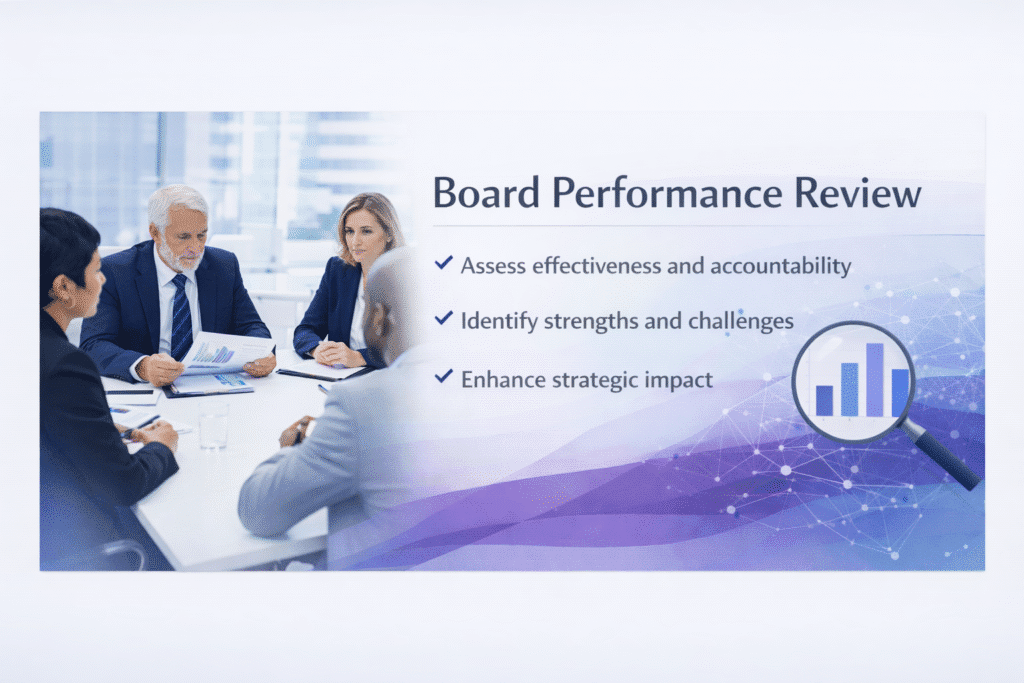
A board performance review that asks whether processes are in place is not a governance review. It is a compliance checklist. The questions that actually determine governance quality are different — and harder: Does the board exercise genuine independent judgment? Does it receive the information it needs in a form it can use? Does the CEO-board relationship enable honest exchange or quietly suppress it? Is the board’s collective decision-making sound under pressure, not just in calm conditions?
Ethical Governance board performance reviews are designed to answer those questions.
What the review examines
Our reviews are structured around the three drivers of the Osmic Governance Architecture™ — because governance quality is determined by the interaction of Leadership Character, Strategic Judgment, and Governance Architecture, not by structural compliance alone.
Board composition and capability: Whether the board’s composition — skills, experience, diversity of perspective — is genuinely suited to the organisation’s strategic context and risk environment. Not whether the skills matrix is complete, but whether the capabilities it documents are being used.
Decision-making quality and oversight discipline: How the board makes decisions under pressure. Whether challenge is genuine or performative. Whether risk framing is adequate or habitual. Whether the board is governing or ratifying.
Information architecture: Whether board papers enable independent assessment or consolidate management’s preferred conclusions. Whether the information reaching the board is complete, timely, and useful — or voluminous, filtered, and late.
Leadership Character and board dynamics The interpersonal and behavioural dynamics that shape how the board actually functions — the patterns of deference, dominance, and silence that determine whether the board’s collective intelligence is genuinely available in the room. This is the dimension most conventional board reviews do not examine and most governance failures turn on.
CEO–board relationship The quality, clarity, and candour of the relationship between the board and the chief executive — including role boundary clarity, mutual accountability, and whether the relationship enables honest governance or suppresses it.
Culture and accountability alignment Whether the accountability culture the board projects is genuine and consistent — and whether the incentive structures operating beneath formal governance reinforce or quietly undermine decision integrity.
What you receive
The review produces a written report with findings structured against each dimension, a clear assessment of where governance strength is genuine and where risk is present, and specific, actionable recommendations. Where the findings indicate that behavioural governance capacity requires deeper measurement, the Governance Architecture Diagnostic™ is available as the next step.
Where the review identifies that behavioural governance capacity requires deeper measurement, the Governance Architecture Diagnostic™ provides the structured instrument for that assessment.
How it is conducted
Reviews are conducted through surveys and structured interviews with board members, the chair, and key executives; analysis of board papers, minutes, and governance documents; and where relevant, direct observation of board processes. All interviews are confidential. The report is provided to the chair and, where requested, presented to the full board.
Who it is for
Board performance reviews are appropriate for any board that takes governance seriously — listed entities, government and statutory bodies, not-for-profits, and regulated organisations. They are particularly valuable at governance transition points: leadership changes, periods of organisational growth or stress, pre-regulatory engagement, or after a governance concern has been raised internally.
Annual or biennial independent reviews are also a mark of governance maturity for organisations that want to demonstrate they are governing — not just complying.
Enquire about a board performance review →
For boards that require an independent external review following a governance concern or ahead of a significant transition, the Independent Governance Review is the appropriate service.