

Why director independence governance frameworks may be measuring the wrong thing— and what boards should be asking instead.
Every year, thousands of directors tick the independence box.
No material financial relationship with the organisation.
No close family ties to management.
Tenure within acceptable limits. Declaration lodged. Governance requirement met.
And yet boards keep failing in ways that structural independence was supposed to prevent.
Star Entertainment. Crown Resorts. AMP.
In each case, boards were populated with directors who met every technical definition of independence. Independent on paper. Independent in disclosure. Independent in every way the framework asked them to be.
So why weren’t they?
Structural independence tells us who a director is not connected to. It tells us nothing about how they think, challenge, or decide.
Structural independence measures the proxy — not the thing itself
Structural independence tells us who a director is not connected to.
It does not tell us how they think, challenge, or decide.
When we talk about director independence, we are almost always referring to structural independence — a set of observable, reportable characteristics used as proxies for objectivity. The ASX Corporate Governance Principles, the Corporations Act, and ASIC guidance all converge on similar criteria:
- Absence of a material financial relationship
- No recent employment with the organisation
- No close family ties to management
- Tenure that has not compromised perspective
These are necessary conditions.
They are not sufficient ones.
Somewhere along the way, governance practice confused the proxy with the thing it was meant to represent.
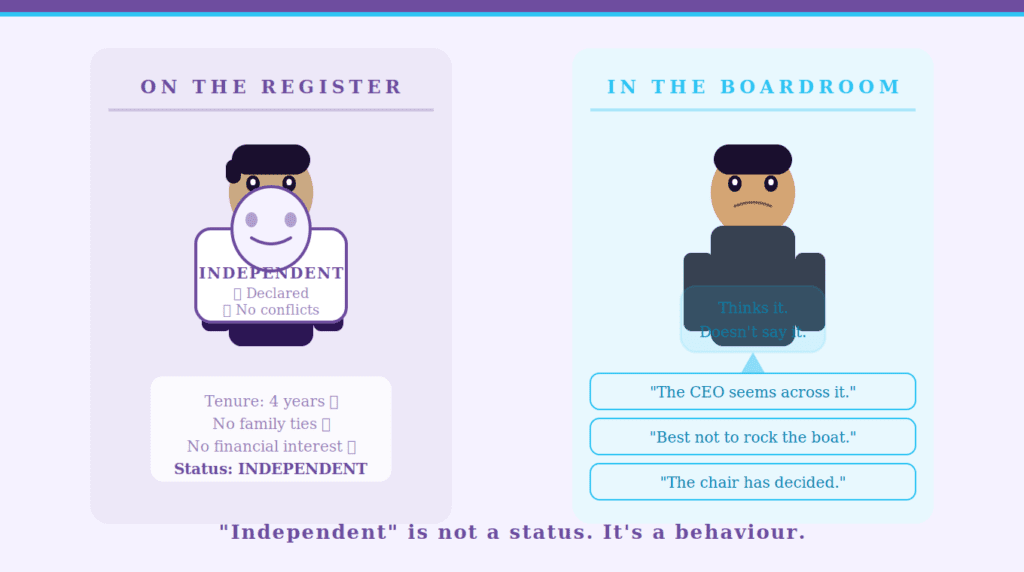
Behavioural independence is where governance actually lives
Behavioural independence is different in kind, not just degree.
It is the capacity — and the willingness — to form and hold a genuinely independent view in the room where decisions are made.
That sounds straightforward.
In practice, it is extraordinarily difficult.
Boardrooms are social environments. They are shaped by hierarchy, relationship history, and the implicit expectation of collegiality. A director who has served alongside the same chair for years, who respects the CEO’s expertise, who values cohesion and does not want to be seen as obstructive — that director may be perfectly independent in structural terms and deeply compromised in behavioural terms.
Not dishonestly.
Not deliberately.
That is precisely what makes it dangerous.
Behavioural independence rarely fails in visible ways. It fails in moments that are almost impossible to observe from the outside:
- The question that does not get asked because the room has moved on
- The risk that is noted but not pressed because management appears confident
- The dissenting view that softens between discussion and formal minutes
- The silence that follows a dominant voice
None of this is captured in a disclosure form.
None of it is visible in a register of interests.
And none of it is addressed by checking that a director has been on the board for fewer than nine years.
Over time, these moments do not remain isolated. They form patterns — and those patterns shape how decisions are actually made.
The most significant governance failures in corporate history have not been caused by directors who lacked structural independence. They have been caused by directors who lacked the behavioural capacity to exercise it.
Governance architecture determines whether independence can exist
Structural independence describes who is in the room.
Governance architecture determines what happens once they are there.
This is the question most boards are not asking:
Even if every director is willing to exercise independent judgement, does the system they operate in actually allow them to do so?
Governance architecture refers to the structures, processes, and conditions that shape board behaviour in practice — how information flows, how agendas are set, how dissent is received, how time is allocated, and what norms exist around challenge and silence.
These are not administrative details. They are governance variables.
Architecture shapes behaviour. A director may be willing to ask the difficult question — but not ask it if the culture treats challenge as poor teamwork. A director may want to interrogate a recommendation — but be unable to do so effectively if the board pack arrives 48 hours before the meeting, runs to hundreds of pages, and is written by the people whose judgement is being assessed.
Independent behaviour does not emerge spontaneously from independent people.
It emerges from governance environments deliberately designed to enable it.
Independence is shaped by patterns, not just people
These dynamics are not isolated. They are systemic.
Over time, boards develop patterns:
- patterns in how information is presented
- patterns in how decisions are framed
- patterns in who speaks, and who does not
Those patterns determine whether independence is exercised — or quietly suppressed.
Two boards can look identical on paper and operate in entirely different ways in practice.
Not because their frameworks are different.
But because their patterns are.
What this means in practice for boards
These factors are often treated as secondary to board composition and formal governance requirements.
In practice, they are the conditions under which director independence either functions — or fails.
Board composition and cognitive diversity
Diversity of perspective matters as much as diversity of background. A board populated with directors who share professional training, social networks, and cognitive frameworks may be structurally diverse and behaviourally homogeneous. The question is not only who is on the board — it is whether the combination of people creates genuine plurality of view.
Chair leadership as a governance variable
The chair is the single most important determinant of whether behavioural independence can function in a boardroom. A chair who signals their own view before others have spoken, who manages time in ways that foreclose discussion, or who treats challenge as disloyalty, is actively suppressing the directors’ independence the governance framework is designed to protect. Chair effectiveness is a governance risk that almost no board formally assesses.
Information architecture shapes decision-making
What the board sees, when it sees it, how it is framed, and by whom — these are not administrative details. They are governance variables. A board that receives only management-prepared material, with no independent access to operational data and no mechanism for external perspectives, is structurally constrained in its ability to exercise independent judgement regardless of how its members are categorised.
Boardroom culture determines whether independence is expressed
The norms that govern how directors interact — how challenge is treated, whether silence is taken as assent, whether there is psychological safety to hold a minority view — are as consequential for governance quality as any structural feature. These dynamics are rarely named, let alone deliberately shaped.
You cannot govern what you cannot see
Most boards cannot see their own behavioural independence — or its absence.
That is the limitation of current governance frameworks.
They assess independence as a status.
They do not assess whether it functions in practice.
The questions boards should be asking
The shift from structural to behavioural independence requires a shift in how boards examine themselves:
- Not: “Do our directors meet independence criteria?”
But: “Can independent judgement actually operate in our boardroom?” - Not: “Have we declared conflicts?”
But: “Are there informal influences shaping our decisions?” - Not: “Is our board balanced?”
But: “Do our dynamics allow real challenge to surface and be heard?”
These are not comfortable questions.
They require boards to examine their own operating reality — something that is difficult to do without structure and external perspective.
Independence is not a status
Independence is not a status conferred at appointment.
It is a behaviour that must be continuously enabled, tested, and sustained.
You cannot govern what you cannot see.
And most boards cannot see their own behavioural independence — or the conditions that enable or constrain it.
This is precisely the gap most governance frameworks leave unresolved.
This is what the Governance Architecture Diagnostic™ is designed to surface.
Not whether a board meets formal independence criteria —
but whether the conditions exist for independence to function in practice.
How decisions are actually made.
Where independent judgement holds — and where it quietly dissolves under pressure.
If your board has never examined that question, it is time to start.
Sanela Osmic GAICD is the Founder and Principal of Ethical Governance. Her work focuses on behavioural governance, governance judgement and decision integrity. She is the developer of the Osmic Governance Architecture™ (OGA) and the author of Leading with Emotional Intelligence: A Guide for Board Directors.
Contact us for more details.
This is insightful
Thank you Jimmy — I appreciate that. It’s an area that often looks straightforward on paper, but becomes much more complex in practice.