
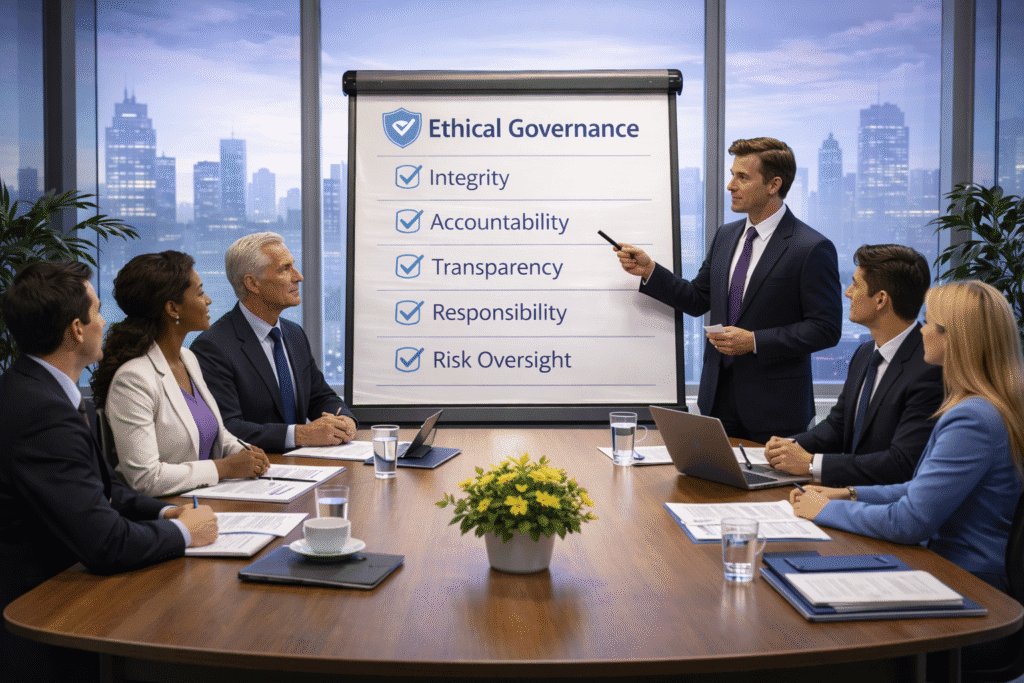
What Is Ethical Governance?
Ethical governance continues to puzzle boards and academics alike – not because it is complex in theory, but because it demands courage in practice. Most organisations believe they have good governance because they have policies, committees, risk registers, and compliance frameworks.
But history repeatedly shows us something uncomfortable:
Organisations with the most policies still experience the biggest governance failures.
Why?
Because compliance is not the same as ethical governance.
Ethical governance is not about what is written in policy.
It is about how decisions are actually made when pressure, power, politics, and risk are present.
Ethical governance is the difference between:
- Following the rules ✔️
- Doing what is right ✔️
And those two are not always the same.
Ethical Governance Defined
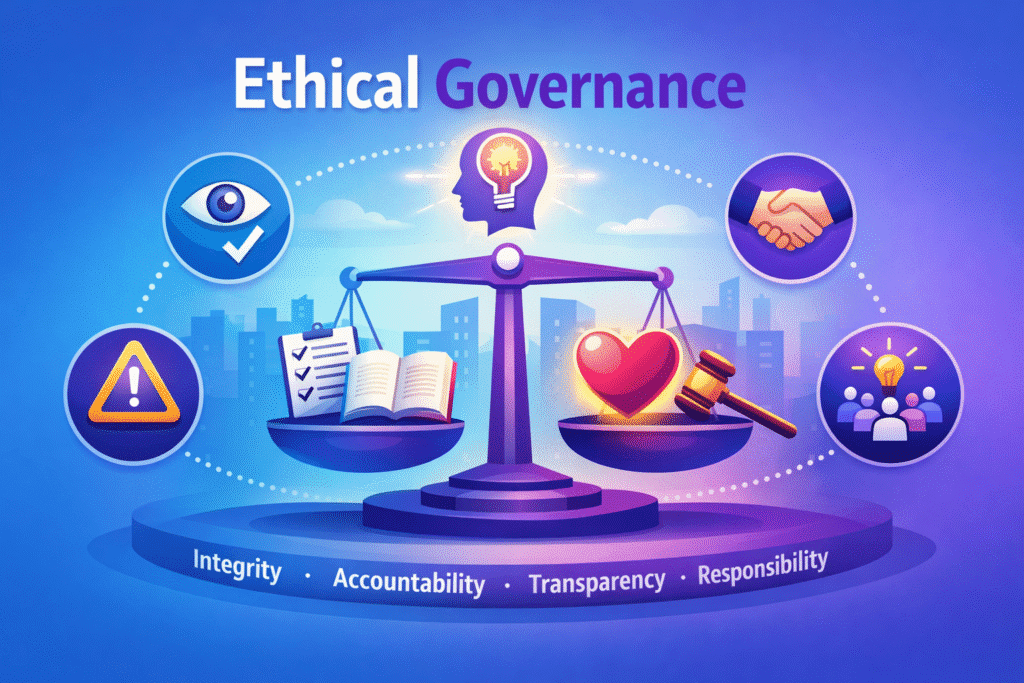
Ethical governance is the practice of guiding decisions, oversight and organisational behaviour through values-based judgement, accountability and integrity – not just compliance. It ensures decisions are defensible, transparent and aligned with long-term organisational purpose and stakeholder trust.
It answers the questions most frameworks ignore:
- Would we be comfortable defending this decision publicly?
- Are we technically compliant but ethically compromised?
- Are we silent because it is easier than speaking up?
- Are we approving risks we would never personally accept?
Ethical governance lives in the behaviours of boards, executives, and leaders – not in documents.
The Theoretical Foundation
Ethical Governance as practised here is grounded in Behavioural Governance — an emerging discipline that examines how leadership character, governance architecture, and strategic judgement interact to determine the integrity of organisational decisions. Where most governance frameworks ask whether the right structures are in place, Behavioural Governance asks what actually determines whether those structures produce sound decisions. That question is at the heart of everything we do.
The Osmic Governance Architecture™
Ethical Governance as practised here is structured through the Osmic Governance Architecture™ — a proprietary behavioural governance framework that identifies three drivers of governance quality: Leadership Character, Governance Architecture, and Strategic Judgment, operating within the cultural and external environments that shape how boards actually behave.
The framework is grounded in original empirical research across documented governance failures across four jurisdictions. It is not a theory borrowed from elsewhere. It was built to explain what structural governance frameworks cannot — why boards with sound processes still make decisions that damage organisations and the people who depend on them.
The Governance Architecture Diagnostic™
The Governance Architecture Diagnostic™ is the instrument that makes the framework operational. It is the first structured tool designed to measure behavioural governance capacity across seven dimensions — from Decision Bias Awareness and Courageous Accountability to Risk Framing & Escalation Discipline — producing a governance risk profile grounded in evidence rather than self-assessment alone.
It is the difference between knowing your governance should work and knowing whether it will.
Ethical Governance vs Compliance Governance
Many boards operate in what we call compliance governance:
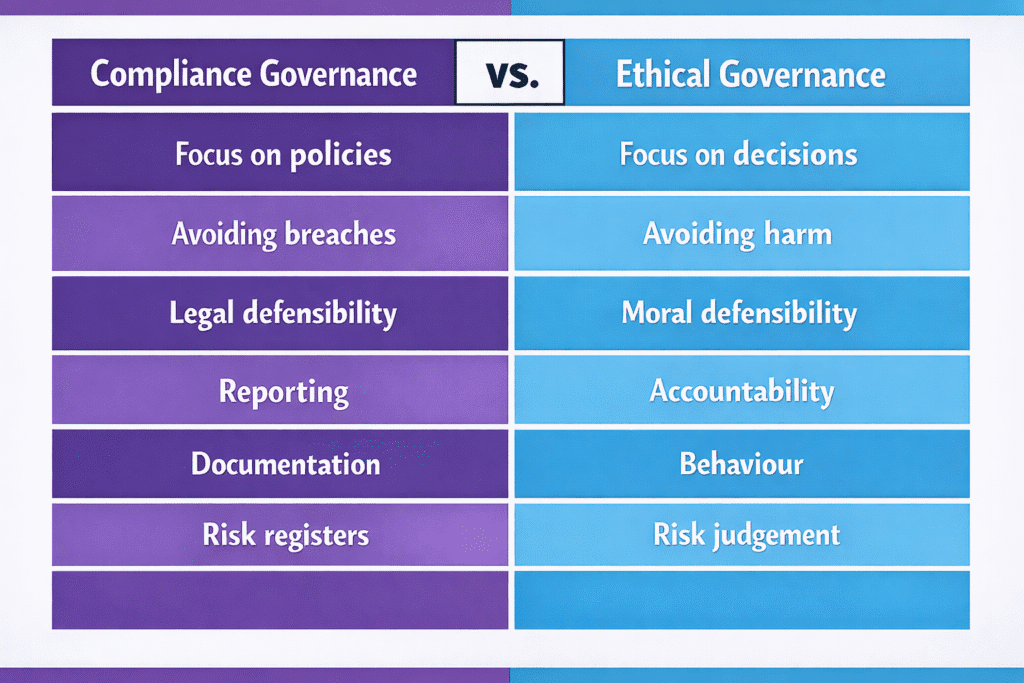
Compliance checks legality and process.
Ethical governance ensures decisions are defensible, justifiable and aligned with organisational values – even under pressure.
What Ethical Governance Looks Like in Practice
Ethical governance is not a “nice-to-have.” It strengthens trust, mitigates reputational and strategic risk, improves decision quality and enhances organisational resilience.
You can recognise ethical governance when:
- Directors ask uncomfortable questions
- Decisions evaluated beyond short-term financial impact
- Executives are challenged respectfully
- Culture supports speaking up
- Risk appetite is discussed honestly, not symbolically
- ESG is embedded in decisions, not reports
- AI, technology, and data decisions consider human impact
- Silence is not mistaken for loyalty
Ethical governance is visible in how people behave when no one is watching.
Why Ethical Governance Matters Now
Modern governance challenges are no longer administrative. They are ethical:
- AI and automated decision-making
- ESG accountability
- Cultural failures and whistleblower cases
- Mergers hiding cultural and behavioural risks
- Risk appetite statements disconnected from real decisions
These cannot be solved with more policies. They require ethical governance.
In this context, ethical governance is not aspirational – it is strategic.
Organisations that embed ethical governance:
- Strengthen stakeholder trust
- Improve decision quality
- Reduce reputational and regulatory risk
- Enhance long-term resilience
- Create sustainable value
Trust has become a competitive advantage.
Integrity has become a performance driver.
Governance That Works Under Pressure
Ethical governance is most visible when tested.
When incentives conflict with values.
When financial pressure increases.
When reputational risk emerges.
When legal compliance allows, but ethical judgement hesitates.
Strong governance systems anticipate these tensions.
Weak ones collapse under them.
The Core Principle
Ethical governance exists to protect one thing above all:
The integrity of decision-making.
Because decisions shape culture.
Culture shapes behaviour.
Behaviour shapes outcomes.
And outcomes define legacy.
Strengthening Ethical Governance
Our work is organised across four areas, each grounded in the Osmic Governance Architecture™:
Assessment: The Governance Architecture Diagnostic™ — measuring behavioural governance capacity across seven dimensions. The only instrument of its kind.
Board Effectiveness: Board Performance Reviews, Independent Governance Reviews, and Emotional Intelligence in the Boardroom — evaluating and strengthening how boards function in practice.
Development: The Integrity Under Pressure Intensive™, Customised Training, and the Demystifying Ethics Masterclass — building the character, judgment, and interpersonal capability that governance depends on.
Advisory: Strategic Consulting — working directly with boards and leadership teams on governance design, board-CEO alignment, culture, and decision integrity.
Ethical governance is not theoretical.
It is designed.
It is built.
It is practised.
And when done well, it becomes an organisation’s greatest strategic asset.
If you want governance that works not only on paper, but in practice:
Contact us to discuss your organisation’s needs and discover how Ethical Governance can support you in achieving ethical excellence.
Together, let’s build a stronger future based on trust, integrity and responsible business practices.
How is this different from a standard board review?
This approach examines behavioural patterns, decision quality, and risk application – not just structural compliance.
Is this suitable for not-for-profits and public sector boards?
Yes. The framework adapts to regulated, community, and government-aligned environments.
You May Also Be Interested In:
Why Governance Fails – Even When Policies Exist
Why Ethical Governance Is a Risk Management Issue (Not a Soft Skill)
Ethical Governance in Boards: Moving Beyond Compliance to Character