
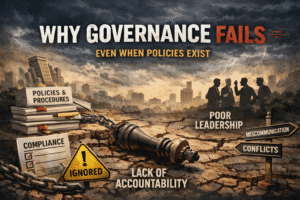
Understanding Governance Failure in Modern Boards
Organizations invest heavily in governance frameworks. They build policies, establish charters, form committees, create risk registers, and conduct compliance audits. On paper, governance appears robust.
Yet governance failure still happens.
Boards collapse. Reputations deteriorate. Ethical misjudgments surface. Strategic decisions unravel under scrutiny.
This raises a fundamental question:
Why does governance fail even when policies exist?
Governance failure not administrative. It is architectural.
Boards can have detailed charters, comprehensive risk registers, codes of conduct, and regulatory compliance – and still produce decisions that damage trust, erode reputation, and expose the organization to long-term risk.
The problem is not the absence of policy.
It is the failure of the system that produces decisions.
The Compliance Illusion
Compliance creates the appearance of control.
Policies are written.
Committees are formed.
Reports are tabled.
Audits are completed.
From the outside, governance appears strong.
But governance is not measured by documentation.
It is measured by the quality of decisions made under pressure.
When urgency rises, when financial stakes increase, when reputational exposure intensifies – that is when governance is tested.
And that is where it often fails.
This distinction between compliance and ethical governance is explored further in our Demystifying Ethics Masterclass.
The Real Causes of Governance Failure
Governance failure typically emerges from a combination of structural, behavioural, and cultural factors. The following dynamics are consistently present in cases of board governance failure.
1. Structural Governance Without Behavioural Alignment
Most governance frameworks focus on structure:
- Board composition
- Committee mandates
- Reporting protocols
- Risk oversight frameworks
However, structure does not determine behaviour.
Boards may have clearly defined roles yet still experience:
- Dominant personalities suppressing challenge
- Informal power hierarchies influencing outcomes
- Directors avoiding uncomfortable questions
- Over-reliance on executive assurances
When behavioural dynamics undermine structural safeguards, governance becomes performative rather than protective.
Strengthening emotional intelligence in the boardroom is critical to preventing behavioural governance failure.
2. Governance Under Pressure: The Distortion of Judgement
Governance does not fail in calm environments.
It fails when pressure rises.
Under time constraints, financial stress, stakeholder scrutiny, or reputational risk, cognitive distortions increase:
- Urgency replaces reflection
- Consensus replaces critical thinking
- Familiarity bias overrides due diligence
- Commercial logic overshadows ethical considerations
This is not incompetence. It is human psychology.
Without explicit safeguards for decision integrity, boards default to efficiency rather than ethical depth.
3. Cultural Drift as an Invisible Risk
Culture is the most underestimated governance risk factor.
Culture determines:
- Whether dissent is welcomed or discouraged
- Whether ethical concerns are raised early
- Whether reputational risk is taken seriously
- Whether directors feel psychologically safe challenging management
If a board culture prioritizes harmony over accountability, governance failure becomes likely – even when policies are flawless.
Cultural misalignment does not appear on risk registers.
But it shapes every decision.
4. Ethical Misjudgment in Boardrooms
Most governance failures are not deliberate acts of misconduct.
They are incremental ethical misjudgments.
Small compromises justified by:
- Commercial necessity
- Competitive pressure
- Short-term financial targets
- Regulatory ambiguity
- Assumptions about stakeholder tolerance
Over time, these justifications compound.
Ethical drift becomes normalized.
Boards often realize the severity of misalignment only after external scrutiny reveals what internal systems ignored.
Governance Failure Is Architectural
If governance fails despite strong policies, the failure is not administrative.
It is architectural.
It reflects misalignment between:
- Leadership behaviour
- Oversight design
- Strategic judgement
- Incentive structures
- Organisational culture
When these elements are fragmented, no policy can compensate.
The system itself produces flawed decisions.
From Policy Sufficiency to Decision Integrity
Traditional governance frameworks ask:
Do we have the right policies?
A more important question is:
Will our governance system consistently produce defensible, ethically sound, purpose-aligned decisions – especially when pressure rises?
That question shifts the focus from compliance sufficiency to decision integrity.
And decision integrity requires alignment.
Introducing a Structural Response
Preventing governance failure requires moving from procedural governance to architectural governance.
The Osmic Governance Architecture™ reframes governance around three interdependent pillars:
- Leadership Character
- Governance Architecture
- Strategic Judgement
When these pillars align – reinforced by cultural and incentive coherence – the outcome is integrity of decision-making.
When they fragment, governance risk escalates, regardless of policy strength.
Governance resilience is not built through documentation volume.
It is built through systemic coherence.
The Executive Responsibility
For Chairs, Directors and CEOs, the implication is clear:
Governance strength is not demonstrated by how well policies are written.
It is demonstrated by how decisions hold up under scrutiny.
Boards must move beyond asking whether governance frameworks exist and begin asking whether their governance architecture is aligned, disciplined and resilient.
Because governance failure does not begin with missing paperwork.
It begins with structural misalignment under pressure.
And architecture determines whether integrity survives.
Boards serious about preventing governance failure should strengthen decision integrity before pressure escalates through structured governance under pressure training.
For boards seeking systemic reform, our strategic governance consulting services help diagnose architectural misalignment before it becomes reputational risk.
Comments