
“Whenever you see a successful business, someone once made a courageous decision.”
Peter Drucker
Making ethical decisions is rarely about intelligence. It is about clarity.
In leadership, governance, and executive roles, decisions are rarely simple. They involve competing interests, financial pressures, reputational risk, stakeholder expectations, incomplete data, and time constraints.
The real challenge is not choosing between obvious right and wrong.
It is choosing between:
- Short-term gain and long-term sustainability
- Legal compliance and moral responsibility
- Speed and due diligence
- Popularity and principle
Strong leaders are not defined by how quickly they decide.
They are defined by how deliberately they decide.
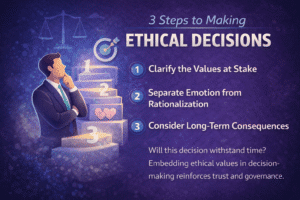
Here are three practical and disciplined steps to making ethical decisions – especially when the stakes are high.
Step 1: Clarify the Values at Stake
Most poor decisions are not made because leaders lack intelligence.
They are made because leaders skip clarity.
Before asking, “What should we do?” ask:
- What values are relevant here?
- Who could be impacted?
- What principle is being tested?
- What trade-offs are we facing?
Decision-making becomes dangerous when framed purely as a commercial or operational issue.
For example:
- A restructuring decision may appear financial – but it is also about fairness and dignity.
- A marketing strategy may appear strategic – but it is also about honesty and transparency.
- A procurement choice may appear cost-based – but it is also about integrity and conflict of interest.
When leaders fail to identify the ethical dimension of a decision, ethical fading occurs. The moral element disappears from view.
Strong decision-makers deliberately bring values into the conversation.
They ask:
- Is this aligned with who we say we are?
- Would we defend this decision publicly?
- If those affected were in this room, would we feel comfortable?
Clarity around values creates boundaries. And boundaries protect leadership credibility.
Step 2: Separate Emotion from Rationalisation
Many poor decisions are emotionally driven – then intellectually justified.
Pressure creates urgency.
Ego creates defensiveness.
Fear creates avoidance.
Pride creates rigidity.
In high-performance environments, leaders are trained to act decisively. But decisive action without emotional awareness can distort judgement.
A powerful discipline in decision-making is to pause and ask:
- Am I reacting, or responding?
- Am I defending my position, or seeking the right outcome?
- Am I rationalising something I already want?
Rationalisation is subtle.
It sounds like:
- “It’s technically compliant.”
- “This is just how the industry works.”
- “We’ll fix it later.”
- “It’s not ideal, but it’s necessary.”
- “We don’t have time to overthink this.”
The human mind is incredibly capable of building convincing narratives around questionable decisions.
The more intelligent the leader, the more sophisticated the justification can become.
Strong leaders develop the discipline to interrogate their own thinking.
One useful technique is perspective testing:
- If a competitor made this decision, would we criticise it?
- If this appeared on the front page tomorrow, would we be comfortable?
- Would I advise a client or colleague to make this same choice?
Separating emotion from ethical judgement does not mean removing emotion entirely.
It means recognising it – so it does not unconsciously control the outcome.
Step 3: Consider Long-Term Consequences
Short-term thinking is one of the greatest threats to ethical and strategic decision-making. Immediate benefits often mask future costs.
Ask:
- What precedent does this set?
- What behaviour does this reinforce?
- How will this decision impact trust?
- What risk does this create in 12 months? In five years?
Reputation is built slowly and damaged quickly.
Trust is accumulated through consistency.
The right decision is rarely the one that delivers the fastest result.
It is the one that protects sustainability.
In governance settings, this requires leaders and boards to shift from “Can we?” to “Should we?”
A decision may be:
- Legal
- Profitable
- Efficient
- Popular
But still wrong.
Long-term thinking forces leaders to weigh impact, not just outcome.
It also requires courage – because the right decision may be slower, less convenient, or more expensive.
But sustainable leadership is built on decisions that withstand time.
Why These Three Steps Matter in Governance
For boards and senior executives, decision-making is not only personal – it is institutional.
Decisions influence:
- Culture
- Risk exposure
- Stakeholder confidence
- Regulatory scrutiny
- Strategic direction
One poorly considered decision can undermine years of reputation-building.
Strong governance frameworks often include:
- Clear delegation authorities
- Risk appetite statements
- Policy guidance
- Reporting mechanisms
But frameworks do not replace judgement. Judgement is developed through discipline.
The three steps – clarifying values, separating emotion from rationalisation, and considering long-term consequences – strengthen that discipline.
Common Barriers to Making Ethical Decisions
Even experienced leaders struggle when:
- There is time pressure.
- Information is incomplete.
- There is internal disagreement.
- There is political sensitivity.
- There are financial consequences.
- There is reputational risk.
In these moments, leaders may prioritise certainty over correctness.
But ethical and strategic maturity requires comfort with discomfort.
Sometimes the right decision is:
- Slower
- More transparent
- More consultative
- More challenging internally
And that is precisely why it protects trust.
The Real Question Behind Every Decision
When leaders ask, “What is the right decision?” they often mean:
“What is the optimal outcome?”
But the better question is:
“What decision can we stand behind – consistently – over time?”
Ethical decisions are not defined only by results.
They are defined by integrity in process.
When process is disciplined, outcomes are more resilient.
Final Reflection
Making ethical decisions is not about perfection. It is about intentionality.
It requires:
- Clarity of values
- Self-awareness under pressure
- Long-term thinking
When leaders embed these three steps into their decision-making process, they strengthen not only outcomes – but credibility.
And credibility is leadership capital.
The most respected leaders are not those who never face difficult decisions.
They are those who face them deliberately.
Because in the end, leadership is not measured by speed or popularity.
It is measured by the consistency between what you say – and what you choose.
And every decision is a signal of who you are.
If you want your decisions to consistently reflect your values – not just your pressures – Ethical Governance works with boards and executive teams to strengthen judgement, align governance frameworks, and embed ethical decision-making into strategy, culture, and leadership practice.
Sanela Osmic GAICD is the Founder of Ethical Governance and the developer of the Osmic Governance Architecture™ and the Governance Architecture Diagnostic™. The GAD™ is available for individual director assessments and full board engagements. Contact us for more details.
Comments