
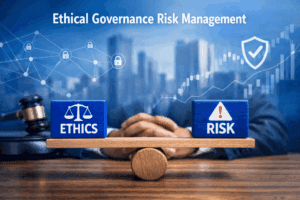
For many organisations, ethical governance is still framed as a “values conversation” — important, but secondary to strategy, financial performance, and risk controls. It is often positioned as cultural, aspirational, or even soft.
This framing is outdated — and increasingly dangerous.
In reality, ethical governance is one of the most critical risk management capabilities an organisation can have. When governance fails, it is rarely because a policy was missing. It fails because judgement broke down, accountability weakened, and ethical considerations were sidelined under pressure.
Boards and executives who treat ethical governance as a soft skill are exposing their organisations to material, reputational, regulatory, and cultural risk.
Ethical Governance Risk Management Is a Board-Level Responsibility
Major organisational failures almost never stem from a lack of frameworks. Most organisations already have:
- Codes of conduct
- Risk registers
- Delegations and policies
- Compliance and reporting structures
Yet governance failures continue to occur — in both public and private sectors.
Why?
Because risk does not live in documents.
Risk lives in:
- Human judgement
- Incentives and pressure
- Group dynamics
- Silence, avoidance, and rationalisation
- Decisions made when information is incomplete and stakes are high
Ethical governance addresses the human side of risk — the part traditional controls cannot reach.
Ethical Governance and Risk: The Direct Link
Ethical governance is fundamentally about how decisions are made, not just what decisions are made. This distinction matters.
When ethics are weak or sidelined:
- Issues are escalated too late
- Uncomfortable truths are softened or avoided
- Short-term gains override long-term consequences
- Accountability becomes blurred
- Culture drifts away from stated values
Each of these is a risk amplifier.
Conversely, strong ethical governance:
- Improves early risk identification
- Strengthens challenge and constructive dissent
- Reduces blind spots and groupthink
- Supports defensible decision-making
- Protects organisational trust and legitimacy
This is not abstract. It is practical risk management.
Why Ethical Governance Risk Management Fails When Ethics Are Treated as “Soft”
Organisations that relegate ethics to training modules or value statements often discover — too late — that the cost is significant.
Common consequences include:
- Reputational damage that outlasts financial recovery
- Regulatory scrutiny and loss of stakeholder confidence
- Cultural erosion and loss of talent
- Board and executive credibility damage
- Long-term trust deficits with communities, customers, and staff
Importantly, these risks are cumulative. They build quietly, often invisibly, until a triggering event exposes them.
This is why ethical governance must be treated as a preventative control, not a reactive response
Ethical Governance Is Tested Under Pressure
Ethical intent is easy to express when decisions are simple. Ethical governance is tested when:
- Trade-offs are uncomfortable
- Performance pressure is intense
- Timeframes are tight
- Information is incomplete
- Reputational risk is looming
These are precisely the conditions under which boards and executives operate.
Without strong ethical governance capability, leaders default to:
- Legal minimums instead of ethical standards
- Silence instead of challenge
- Speed instead of judgement
- Consensus instead of accountability
Over time, this becomes embedded behaviour — and risk exposure increases.
Boards Have a Critical Role
Boards sit at the centre of ethical risk oversight. Their responsibility extends beyond compliance into tone, conduct, and decision discipline.
Key board-level ethical governance responsibilities include:
- Setting and modelling ethical expectations
- Ensuring ethical considerations are integrated into decision-making
- Monitoring culture and behavioural risk, not just financial risk
- Creating psychological safety for challenge and escalation
- Holding leadership accountable for how outcomes are achieved
This is why services such as Board Performance Evaluation and board culture assessments are critical risk tools — not governance formalities.
Emotional Intelligence: The Missing Capability in Ethical Governance Risk Management
One of the most overlooked aspects of ethical governance is emotional intelligence.
Risk escalates when leaders:
- Avoid discomfort
- Personalise challenge
- Deflect responsibility
- React defensively
- Suppress dissent
Emotional intelligence enables leaders to:
- Sit with tension without rushing to resolution
- Separate ego from accountability
- Listen under pressure
- Make values-aligned decisions in complexity
This is why integrating emotional intelligence into governance practice materially strengthens risk management.
Ethical Governance Is About Defensibility
n an environment of growing expectations and scrutiny, decisions are judged not only by outcomes — but by process.
Stakeholders increasingly ask:
- Was the decision ethical, not just legal?
- Were risks genuinely considered?
- Was there appropriate challenge?
- Were values applied consistently?
Ethical governance provides decision defensibility — the ability to explain, justify, and stand behind decisions when scrutinised.
This is particularly critical for:
- Boards and executives
- Government and public sector organisations
- Regulated industries
- Organisations with social or community impact
Defensibility is a risk shield. Ethics is how it is built.
Why Ethical Governance Risk Management Must Be Embedded, Not Documented
The most effective organisations embed ethical governance into:
- Board and executive conversations
- Decision frameworks
- Performance expectations
- Leadership development
- Everyday behaviours
This requires moving beyond compliance into capability-building. Services such as board training, culture assessments and governance reviews are most effective when they are treated as risk interventions — deliberately designed to strengthen judgement, accountability, and decision-making under pressure — rather than as optional development activities.
A Final Word to Boards and Leaders
Ethical governance is not a “nice to have”.
It is not a branding exercise.
And it is certainly not a soft skill.
It is a core risk management discipline — one that protects organisations when pressure is high, scrutiny is intense, and decisions matter most.
Boards and leaders who invest in ethical governance are not being idealistic. They are being prudent.
Because when ethics fail, risk follows.
Ready to Strengthen Ethical Governance?
If your board or leadership team is navigating complexity, risk, or cultural pressure, Ethical Governance can support you with practical, tailored governance solutions that stand up under scrutiny.
Contact us to explore how ethical governance can strengthen risk management, decision-making, and trust across your organisation.
Comments