
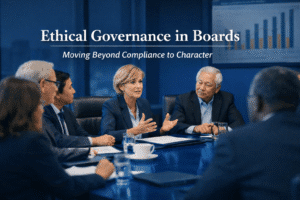
Ethical governance is often spoken about in aspirational terms – integrity, transparency, accountability. Yet in boardrooms, it is tested in far more practical and uncomfortable ways: in how decisions are made under pressure, how dissent is handled, how conflicts are declared, how risks are framed, and how silence is interpreted.
Ethical governance in boards is not a slogan. It is not a values statement framed on a wall. It is the lived discipline of ensuring that power is exercised responsibly, decisions are made transparently, and organisational purpose is protected – especially when it is inconvenient to do so.
This article explores what ethical governance truly means in a board context, why it matters, where boards often drift, and how to embed it as a structural capability rather than a personal virtue.
What Is Ethical Governance at Board Level?
At its core, ethical governance is the integration of moral judgement with formal governance responsibilities.
It sits at the intersection of:
- Fiduciary duty
- Strategic oversight
- Risk governance
- Cultural stewardship
- Stakeholder accountability
Ethical governance asks not only:
- Is this legally permissible?
- Is this financially viable?
But also:
- Is this fair?
- Is this aligned with our stated values?
- Who might be unintentionally harmed?
- Would we be comfortable defending this decision publicly?
Boards operate within legal frameworks. Ethical governance ensures they also operate within principled ones.
Why Ethical Governance Matters More Than Ever
Modern boards are operating in environments characterised by:
- Heightened regulatory scrutiny
- Social media transparency
- Increased stakeholder activism
- Complex funding and compliance landscapes
- Cultural and reputational risk exposure
In this context, governance failure rarely begins with criminality. It begins with small ethical compromises:
- A report that is “technically correct” but incomplete
- A tender margin that is unclear but accepted
- A cultural issue acknowledged but not escalated
- A dissenting voice subtly discouraged
Ethical governance acts as a preventative discipline. It strengthens resilience before crisis emerges.
The Difference Between Compliance and Ethical Governance
Compliance asks:
“Are we meeting our legal obligations?”
Ethical governance asks:
“Are we meeting our moral obligations?”
A board can be compliant and still be ethically weak.
Examples of ethical drift despite compliance:
- Decisions driven primarily by optics rather than substance
- Risk appetite defined but not meaningfully applied
- Culture reported through metrics but not interrogated
- Loyalty mistaken for alignment
Ethical governance requires boards to move beyond box-ticking into reflective oversight.
The Five Pillars of Ethical Governance in Boards
1. Clarity of Purpose
Ethical boards consistently test decisions against organisational purpose.
When financial pressures arise, the ethical question becomes:
- Does this decision advance our mission, or protect short-term comfort?
Boards that lose clarity of purpose often rationalise decisions that slowly erode trust.
2. Integrity in Decision-Making
Integrity at board level shows up through:
- Transparent declaration of conflicts
- Clear articulation of decision rationale
- Documented consideration of risk trade-offs
- Willingness to revisit decisions if new information arises
Ethical boards do not hide behind collective language to avoid accountability.
They record not just decisions, but reasoning.
3. Courage to Challenge
One of the greatest threats to ethical governance is silence.
When boards confuse harmony with effectiveness, governance weakens.
Ethical boards:
- Encourage dissent
- Protect minority viewpoints
- Invite structured challenge
- Separate personal discomfort from governance responsibility
Constructive challenge is not disruption. It is stewardship.
4. Cultural Oversight
Culture is not an operational issue alone. It is a governance issue.
Boards have responsibility to monitor:
- Psychological safety
- Whistleblower confidence
- Leadership behaviour patterns
- Reward structures and incentives
Ethical governance asks:
- What behaviours are being reinforced?
- What behaviours are being tolerated?
- What behaviours are being ignored?
If behaviour contradicts stated values, governance intervention is required.
5. Risk with Moral Context
Risk registers are technical tools. Ethical governance ensures they carry human context.
For example:
- Financial risk without considering community impact
- Workforce risk without considering wellbeing
- Reputational risk framed only in terms of media exposure
Ethical boards assess not only probability and impact – but fairness and consequence.
Where Boards Commonly Drift
Even capable boards experience ethical drift. Common patterns include:
Strategic Ambiguity
When strategy development is prolonged, unclear, or poorly implemented, ethical governance suffers because:
- Decision-making becomes reactive
- Reporting becomes operationally cluttered
- Accountability blurs
Clarity is ethical. Ambiguity creates room for compromise.
Information Overload or Opacity
If management papers do not clearly articulate:
- Total costs
- Profit margins
- Trade-offs
- Risk exposure
The board cannot exercise ethical oversight effectively.
Ethical governance depends on high-quality, transparent information.
Homogeneity of Perspective
Boards composed primarily of individuals from similar professional or socio-economic backgrounds may unintentionally limit diversity of thought.
Ethical governance requires:
- Diverse lived experience
- Sector diversity
- Cognitive diversity
Without diversity, blind spots become systemic.
Ethical Governance and Emotional Intelligence
Boards often underestimate the role of emotional intelligence in governance.
Yet many governance failures are emotional before they are structural:
- Avoidance of difficult conversations
- Ego-driven decision-making
- Defensive responses to challenge
- Attachment to being “right” rather than being accurate
Emotionally intelligent boards:
- Recognise triggers
- Separate identity from issue
- Reflect before reacting
- Model disciplined behaviour
Self-awareness at board level strengthens collective decision-making.
Practical Steps to Strengthen Ethical Governance
Ethical governance is not aspirational. It is operational.
Boards can embed it through:
1. Structured Ethical Reflection
Before major decisions, include one formal question:
- What ethical risks are present in this decision?
Normalise ethical language in governance discussions.
2. Clear Decision Papers
Require papers to clearly state:
- Financial implications
- Risk exposure
- Alternative options considered
- Stakeholder impact
Clarity strengthens integrity.
3. Regular Board Evaluations
Independent board reviews can identify:
- Cultural silence
- Decision-making gaps
- Risk appetite misalignment
- Role confusion
Evaluation is not criticism. It is governance maturity.
4. Succession Planning with Intent
Proactively align board composition to:
- Emerging strategic challenges
- Regulatory complexity
- Community representation
Ethical governance evolves with organisational context.
5. Chair Leadership Discipline
Chairs play a critical role in ethical governance by:
- Encouraging respectful challenge
- Preventing dominance
- Ensuring balanced participation
- Framing issues clearly
Tone at the top influences board culture.
Ethical Governance as a Strategic Advantage
Ethical governance is not defensive. It is strategic.
Boards that consistently demonstrate ethical maturity:
- Build stronger stakeholder trust
- Attract higher-quality directors
- Reduce regulatory exposure
- Enhance executive accountability
- Improve decision confidence
Trust compounds over time. So does erosion.
The Reality: Ethical Governance Is a Choice
No board sets out to govern unethically.
Drift happens gradually:
- Through fatigue
- Through familiarity
- Through pressure
- Through silence
Ethical governance requires conscious discipline.
It requires directors who are willing to ask:
- Are we being honest with ourselves?
- Are we challenging enough?
- Are we protecting purpose?
It requires courage – not confrontation.
Clarity – not complexity.
Integrity – not perfection.
Conclusion: Governance Is Character in Structure
Ultimately, ethical governance is character expressed through governance systems.
It is where:
- Structure meets values
- Oversight meets conscience
- Strategy meets accountability
Boards that commit to ethical governance do more than comply.
They steward.
And in doing so, they protect not only their organisations —
but the communities, stakeholders, and futures entrusted to them.
If your board is navigating complexity, cultural risk, or strategic ambiguity, strengthening ethical governance may be the most important investment you can make — not only for compliance, but for long-term credibility and impact.
Ethical governance is not an aspiration.
It is a discipline.
If your board is ready to move beyond compliance and embed ethical governance as a lived discipline, contact Ethical Governance for a confidential conversation.
Sanela Osmic GAICD is the Founder of Ethical Governance and the developer of the Osmic Governance Architecture™ and the Governance Architecture Diagnostic™. The GAD is available for individual director assessments and full board engagements. Contact us for more details.
Comments